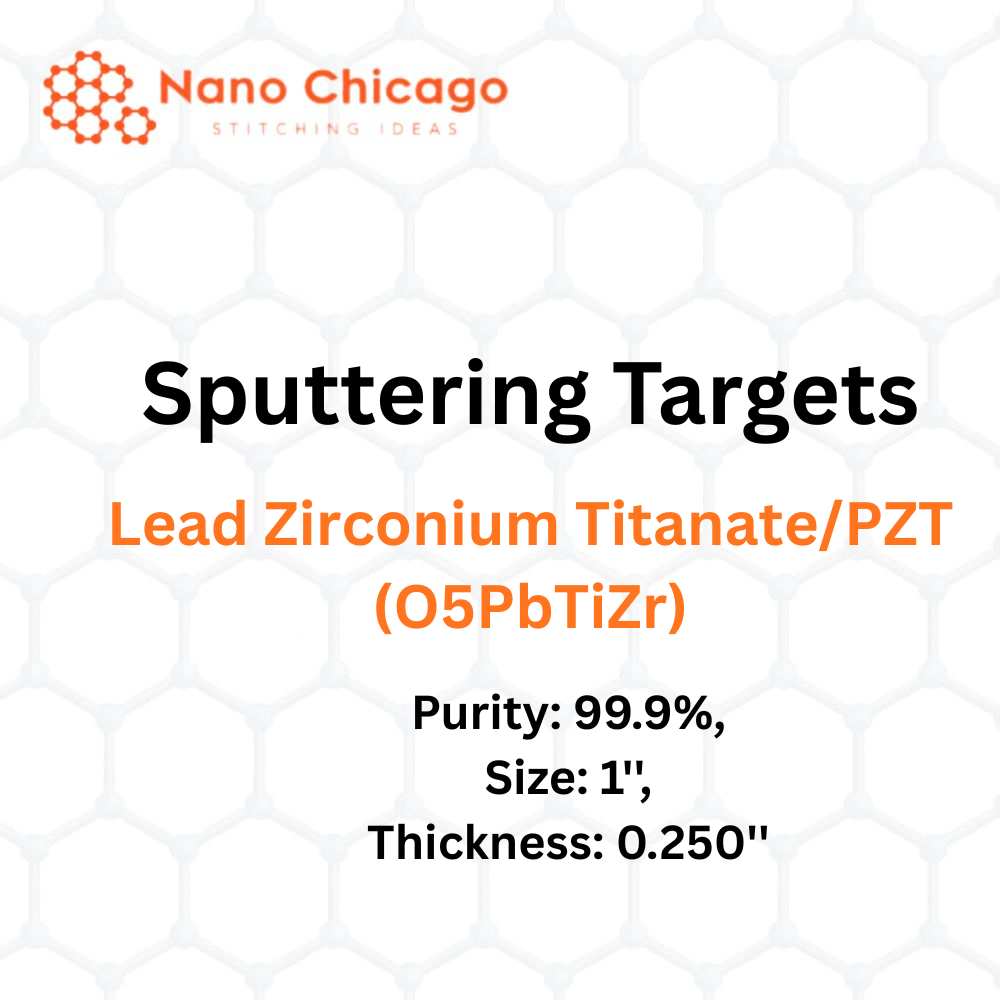
Lead Zirconium Titanate/PZT (O5PbTiZr) Sputtering Targets
Specifications
| Property | Value |
|---|---|
| Purity | 99.9% |
| Size | 1” |
| Thickness | 0.250” |
Sputtering is a proven technology capable of depositing thin films from a wide variety of materials onto diverse substrate shapes and sizes.
The process using sputter targets is repeatable and can be scaled up from small research and development projects. Sputter targets can be adapted to production batches involving medium to large substrate areas. Chemical reactions may occur on the target surface, in-flight, or on the substrate depending on the process parameters.
These numerous parameters make sputter deposition a complex process but give experts significant control over the growth and microstructure of the film.
Applications of Sputtering Targets
Sputtering targets are used for film deposition. Thin-film deposition through sputtering involves eroding material from a “target” and transferring it onto a “substrate,” such as a silicon wafer.
Semiconductor sputtering targets are also used for etching. Sputter etching is selected when a high degree of anisotropy is required and selectivity is not a major concern.
Sputter targets are used for analysis by gradually etching away the material. One example is secondary ion spectroscopy (SIMS), where the target sample is sputtered at a constant rate. As the material is removed, the concentration and identity of sputtered atoms are measured using mass spectrometry. With the help of the sputtering target, the composition of the target material can be determined, and even extremely low impurity concentrations can be detected.
Sputtering also plays a role in space applications. It is one of the processes involved in space weathering, which alters the physical and chemical properties of airless bodies such as asteroids and the Moon.
Lead Zirconium Titanate Information
Lead zirconium titanate is an inorganic ceramic perovskite material known for its strong piezoelectric effect, meaning it changes shape when an electric field is applied. It is widely used in practical applications such as ultrasonic transducers and piezoelectric resonators.
Preparation of PZT Thin Films
The preparation of PZT thin films has been developed using several techniques, including the sol-gel process, pulsed laser deposition, radio frequency (RF) magnetron sputtering, and metal organic chemical vapour deposition (MOCVD). These methods can influence the electrical and structural properties of the resulting thin films.
RF magnetron sputtering is considered one of the most reliable techniques because it produces thin films with excellent uniformity and smooth surface quality.