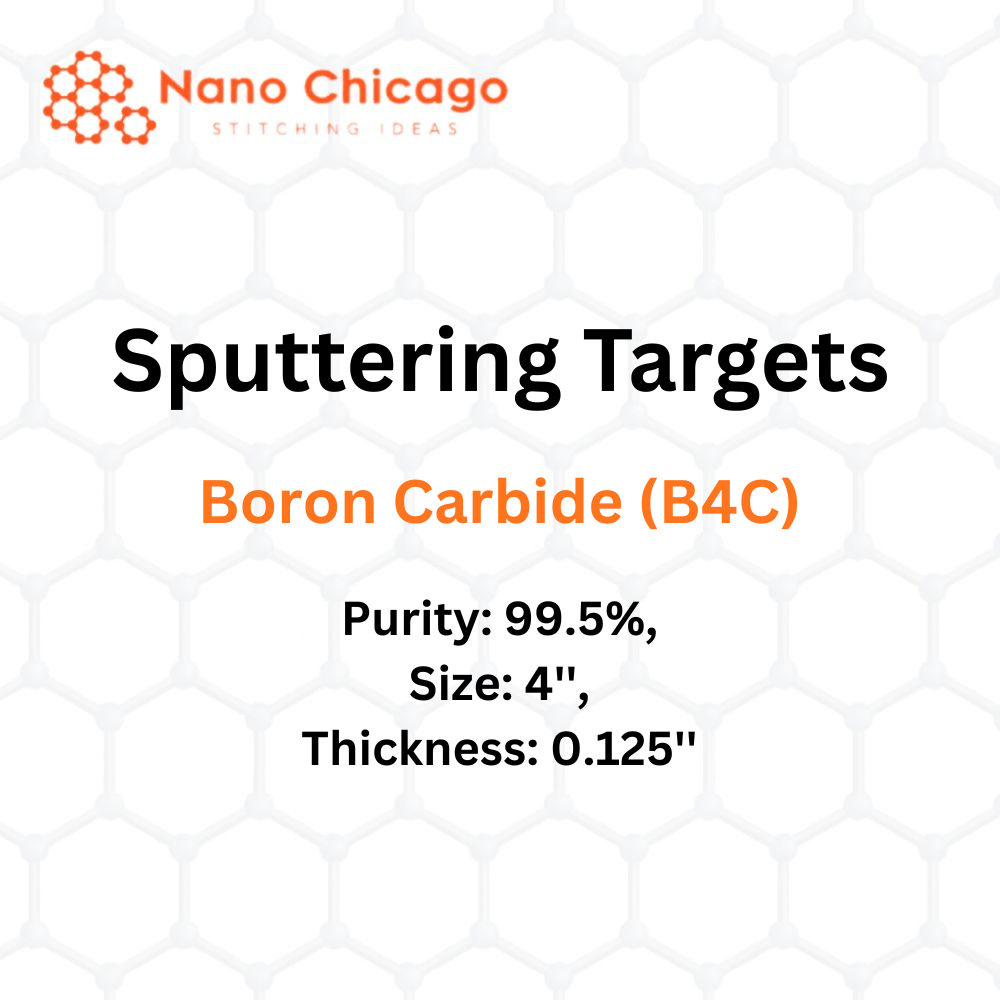
Boron Carbide (B4C) Sputtering Targets
Purity: 99.5% Size: 4” Thickness: 0.125”
Sputtering is a reliable technology used to deposit thin films from a wide range of materials onto diverse substrate shapes and sizes. The process with sputter targets is repeatable and scalable, ranging from small research and development projects to larger production batches involving medium to large substrate areas. Chemical reactions may occur on the target surface, in-flight, or on the substrate depending on process parameters. While sputter deposition involves multiple variables, it provides experts with precise control over film growth and microstructure.
Applications of Sputtering Targets
Sputtering targets are primarily used for thin film deposition. The process involves eroding material from a “target” source onto a “substrate,” such as a silicon wafer.
-
Semiconductor applications: Sputtering targets are used for etching where high etching anisotropy is required, and selectivity is less critical.
-
Analytical purposes: Targets are used in techniques like secondary ion spectroscopy (SIMS), where sputtered atoms are analyzed via mass spectrometry to determine material composition and detect trace impurities.
-
Space applications: Sputtering occurs as a form of space weathering, altering the physical and chemical properties of airless bodies like asteroids and the Moon.
Boron Nitride Overview
Boron nitride (BN) is a heat- and chemically-resistant refractory compound of boron and nitrogen. It exists in several crystalline forms, isoelectronic with carbon lattices. The hexagonal form (h-BN), analogous to graphite, is soft and stable, used as a lubricant and in cosmetic products. The cubic form (c-BN) is analogous to diamond—softer than diamond but with superior thermal and chemical stability—making it ideal for high-temperature equipment.
Properties and Coating Applications
Cubic boron nitride (c-BN) is a key coating material for cutting tools due to:
-
High hardness
-
Low friction coefficient
-
Excellent thermal conductivity
-
High electrical resistivity
-
Exceptional wear resistance
-
Chemical inertness at elevated temperatures
Boron nitride is the hardest material after diamond and exceeds diamond in chemical stability against oxygen and ferrous materials at high temperatures.
Polymorphs:
-
Hexagonal BN (h-BN): Soft, lubricating, electrically insulating, thermally conductive; used in metal forming dies and high-temperature processes.
-
Cubic BN (c-BN): Hard, chemically inert, ideal for cutting tools; used in dry cutting, high-speed machining, and hard material processing.
Sintered c-BN tools are widely used but have drawbacks like high cost, poor ductility, and difficulty forming complex shapes.