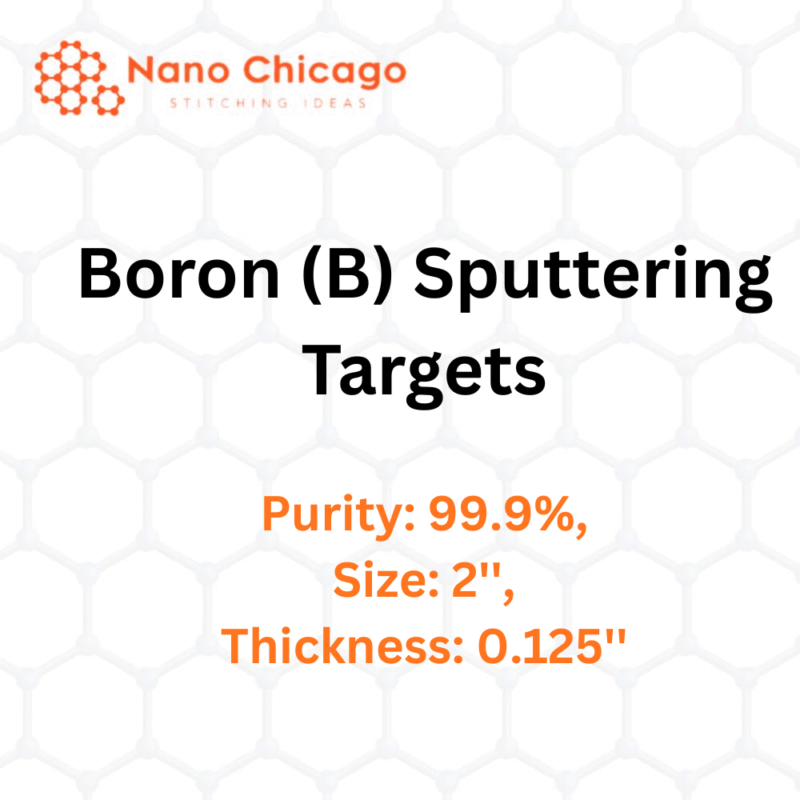
Boron (B) Sputtering Targets, Elastomer
Purity: 99.9% Size: 2” Thickness: 0.125”
Sputtering is a versatile technique for depositing thin films from a variety of materials onto substrates of different shapes and sizes. The process with sputter targets is reproducible, scalable, and suitable for both small R&D projects and larger production batches. Depending on the process parameters, chemical reactions may occur on the target surface, in-flight, or on the substrate. While sputtering involves multiple variables, it provides experts precise control over film growth and microstructure.
Applications of Sputtering Targets
-
Thin Film Deposition: Transfers material from a target onto substrates such as silicon wafers.
-
Semiconductor Etching: Sputter etching is applied where high etching anisotropy is required and selectivity is less critical.
-
Analytical Techniques: Used in secondary ion mass spectrometry (SIMS) to determine target composition and detect trace impurities.
-
Space Applications: Sputtering occurs in space weathering, altering the physical and chemical properties of airless bodies like asteroids and the Moon.
Boron and Boron-Containing Coatings
Boron is widely employed in ion implantation, thin film applications, and surface modification. Common uses include:
-
Ion-beam doping of semiconductors
-
Synthesis of boron-containing films and coatings, such as boron nitride
-
Trench filling in particle detectors
Boron-based coatings enhance surface properties with high hardness, toughness, corrosion resistance, and wear resistance, in some cases approaching diamond-like performance.
Magnetron Sputtering:
-
Boron-containing coatings are often produced using planar magnetron targets, where a non-boron component may help form the desired boron compound film or provide electrical conductivity.
-
Pure boron targets are frequently used in semiconductor doping and for depositing boron nitride films via reactive magnetron sputtering in a nitrogen atmosphere.