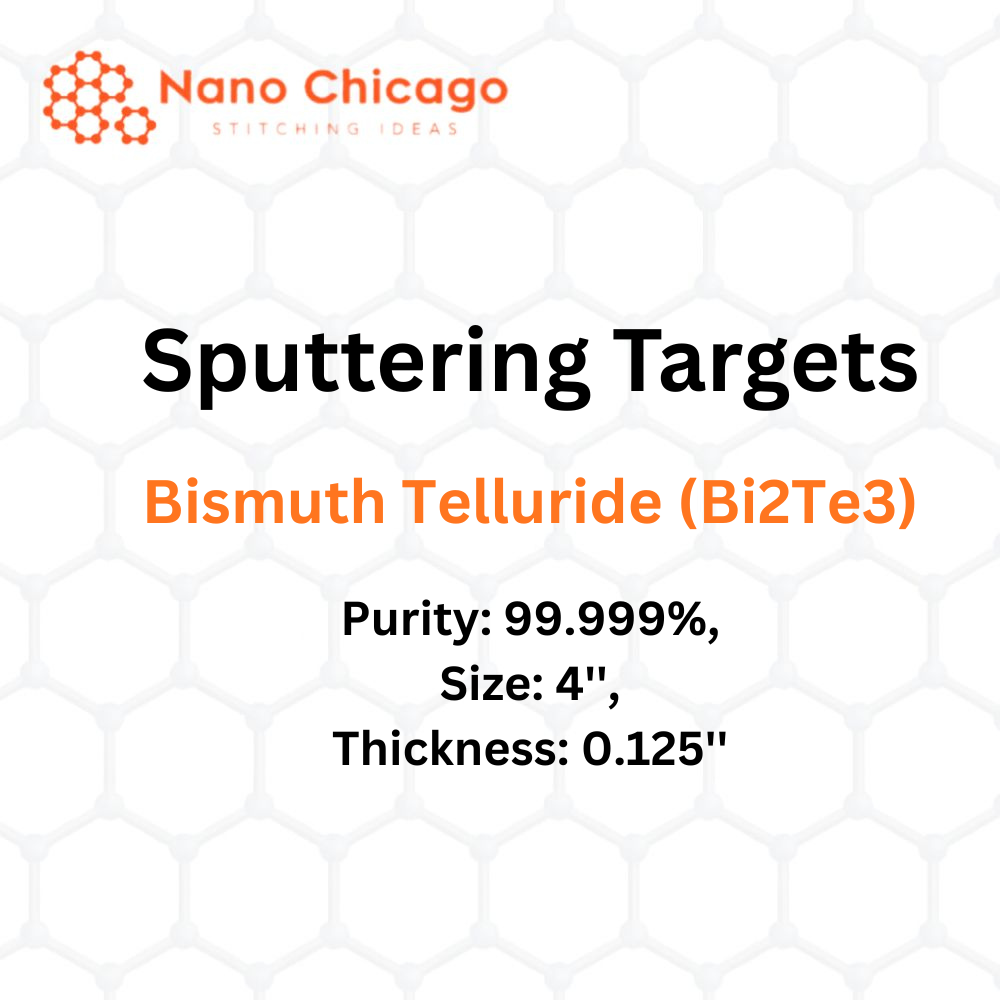
Bismuth Telluride (Bi₂Te₃) Sputtering Targets
Purity: 99.999% Size: 4” Thickness: 0.125”
Sputtering is a reliable method for depositing thin films from a variety of materials onto diverse substrate shapes and sizes. This process is repeatable and scalable, making it suitable for both small R&D projects and medium-to-large production batches. Chemical reactions may occur on the target surface, in-flight, or on the substrate, depending on process parameters. Despite its complexity, sputter deposition provides precise control over film growth and microstructure.
Applications of Sputtering Targets
-
Thin Film Deposition: Material from the target is deposited onto substrates such as silicon wafers.
-
Semiconductor Etching: Sputter etching is used when high etching anisotropy is required, and selectivity is not critical.
-
Analytical Techniques: Secondary ion mass spectrometry (SIMS) uses sputtering to measure the concentration and identity of atoms, detecting even trace impurities.
-
Space Applications: Sputtering contributes to space weathering, altering the physical and chemical properties of airless bodies like asteroids and the Moon.
Bismuth Telluride in Thin Films
Bismuth telluride (Bi₂Te₃) is a gray semiconductor compound of bismuth and tellurium. When alloyed with antimony or selenium, it becomes an efficient thermoelectric material for refrigeration or portable power generation. Bi₂Te₃ also functions as a topological insulator, exhibiting thickness-dependent physical properties.
-
Thermoelectric Devices: Bi₂Te₃ alloys are widely used in bulk thermoelectric devices operating near ambient temperature.
-
Thin Film Applications: Nanostructured Bi₂Te₃ thin films are increasingly used for chip-scale micro-coolers for thermal management and flexible micro-power generators for energy harvesting.
-
Enhanced Performance: Advances in nanotechnology have improved thermoelectric efficiency in well-ordered thin films, exceeding the performance of bulk materials.
-
Research Considerations: Composition, microstructure, morphology, thickness, stress-strain, and substrate conditions significantly influence the thermoelectric properties of Bi₂Te₃ thin films.