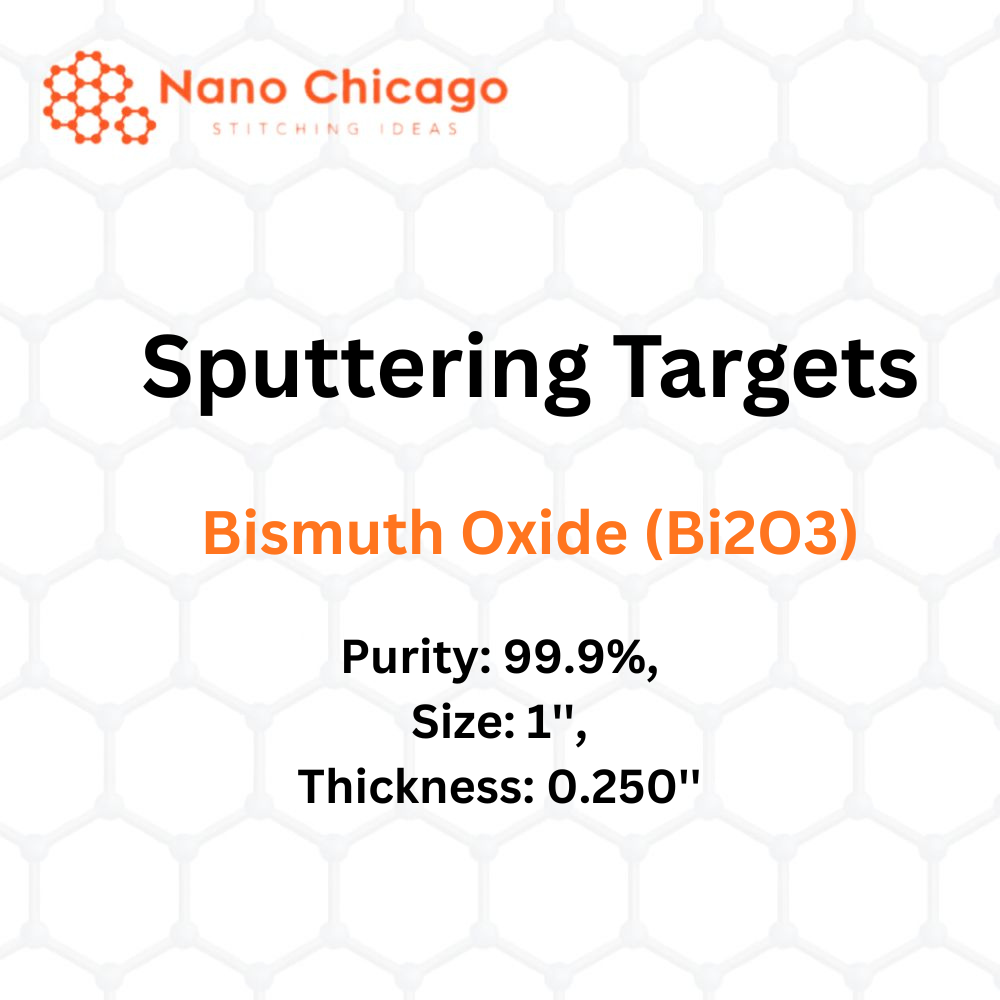
Bismuth Oxide (Bi₂O₃) Sputtering Targets
Purity: 99.9% Size: 1” Thickness: 0.250”
Sputtering is a reliable and widely used method for depositing thin films from a broad range of materials onto substrates of various shapes and sizes. The process is highly repeatable and scalable, making it suitable for research and development as well as medium- to large-area production. Depending on the process parameters, chemical reactions may occur on the target surface, during particle transport, or on the substrate. Although sputter deposition involves many variables, this complexity allows precise control over the resulting film structure and properties.
Applications of Sputtering Targets
Thin Film Deposition
Sputtering targets are used to form thin films by eroding material from a “target” and depositing it onto a substrate such as silicon wafers.
Semiconductor Processing
Sputter etching provides high anisotropy and is used when directional etching is required without strong concerns for material selectivity.
Surface Analysis
In techniques such as Secondary Ion Mass Spectroscopy (SIMS), sputtering removes material at a controlled rate. The sputtered atoms are analyzed to determine composition and detect extremely low-level impurities with high sensitivity.
Space and Planetary Science
Sputtering contributes to space weathering, altering the physical and chemical properties of airless bodies like asteroids and the Moon.
Material Overview: Bismuth Oxide (Bi₂O₃)
Bismuth oxide (Bi₂O₃) is one of the most significant bismuth-based compounds and has been widely studied for its outstanding optical and electrical properties. These include:
-
Wide energy bandgap (2–4 eV)
-
High refractive index
-
High oxygen-ion conductivity at medium and elevated temperatures
These features make Bi₂O₃ a strong candidate for use in:
-
Optoelectronic devices
-
Solar cells
-
Solid oxide fuel cells (SOFCs)
Bi₂O₃ exists in several polymorphic forms—α, β, γ, and δ—each with distinct crystal structures and corresponding optical, electrical, and mechanical characteristics. Among these, the monoclinic α-phase (stable at low temperatures) and the cubic δ-phase (stable at high temperatures) are the only stable forms, while the others are metastable.
Magnetron Sputtering and Functional Applications
Magnetron sputtering is commonly used for Bi₂O₃ thin films due to its high deposition rate, dense and adhesive coating quality, and compatibility with large-area deposition systems.
Bi₂O₃ thin films exhibit high ionic conductivity, making them suitable for applications such as:
-
SOFC electrolytes
-
Oxygen sensors
-
Gas sensors
Additionally, bismuth oxide materials offer:
-
High dielectric permittivity
-
High refractive index
-
Strong photoluminescence
-
Excellent photocatalytic performance under visible light (for water splitting and environmental remediation)
Bismuth-containing mixed-metal oxides are also promising for microelectronics due to their high charge-carrier mobility and long electron mean free path. Furthermore, thin bismuth films transition from semi-metallic to semiconducting at thicknesses around 30 nm, opening additional possibilities for nanoelectronic applications.