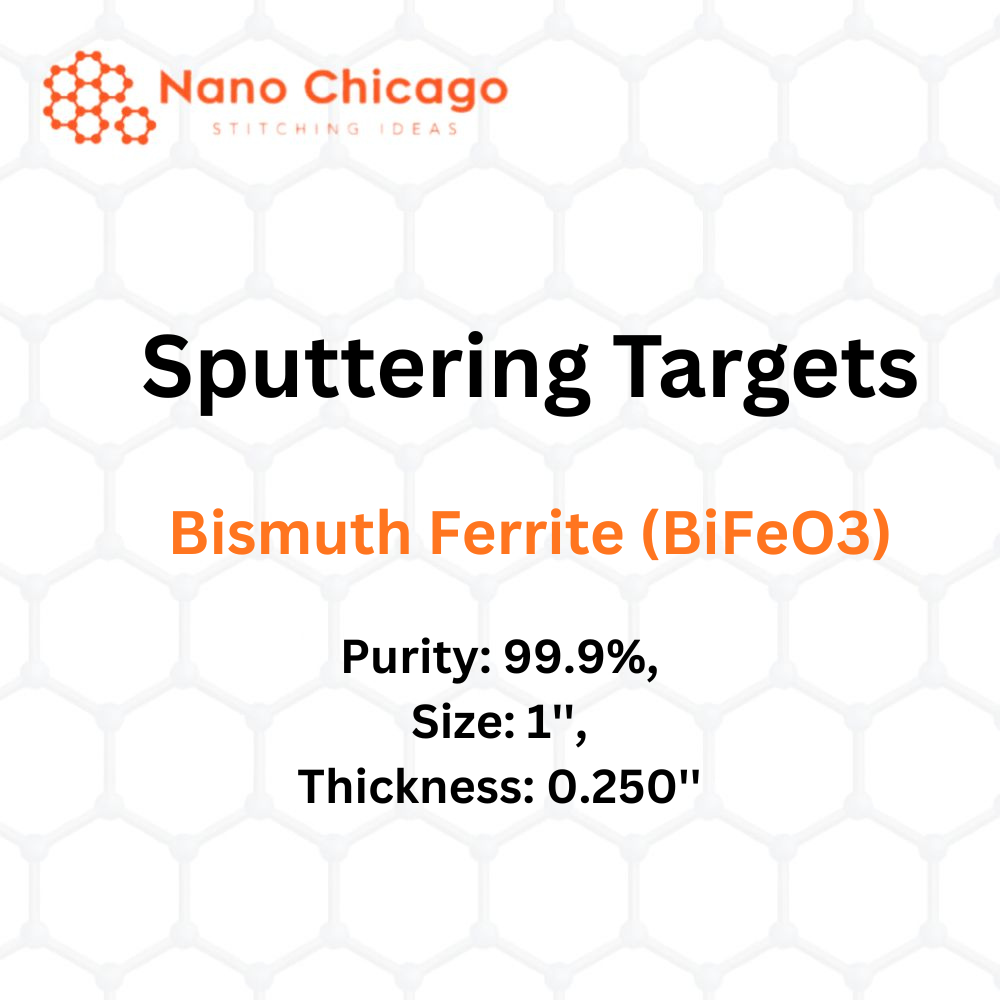
Bismuth Ferrite (BiFeO3) Sputtering Targets, Indium
Purity: 99.9% Size: 1” Thickness: 0.250”
Sputtering is a reliable method for depositing thin films from a wide range of materials onto various substrate shapes. The process is repeatable and scalable, suitable for both small research projects and medium-to-large production batches. Chemical reactions can occur on the target surface, in-flight, or on the substrate depending on process parameters, offering precise control over film growth and microstructure.
Applications of Sputtering Targets
-
Thin Film Deposition: Transfers material from the target to substrates such as silicon wafers.
-
Semiconductor Etching: Ideal when high etching anisotropy is required without selectivity concerns.
-
Analytical Techniques: Supports methods like Secondary Ion Mass Spectroscopy (SIMS) to measure composition and detect trace impurities.
-
Space Applications: Plays a role in space weathering, altering the physical and chemical properties of airless bodies like asteroids and the Moon.
About Bismuth Ferrite (BiFeO3)
Bismuth ferrite (BiFeO3) is an inorganic perovskite-structured compound and a highly promising multiferroic material. Targets are typically prepared via high-temperature sintering or recrystallization of Bi and Fe oxide compounds to produce single-phase BiFeO3. Indium bonding is recommended for optimal performance.
This Pb-free ferroelectric material exhibits outstanding properties, including large remnant polarization, high Curie temperature, and high antiferromagnetic Néel temperature. It uniquely combines magnetic and ferroelectric properties at and above room temperature. Its strong polarization-induced photovoltaic effect and 3.3 eV direct band gap make BiFeO3 films ideal for advanced ferroelectric photovoltaic research.