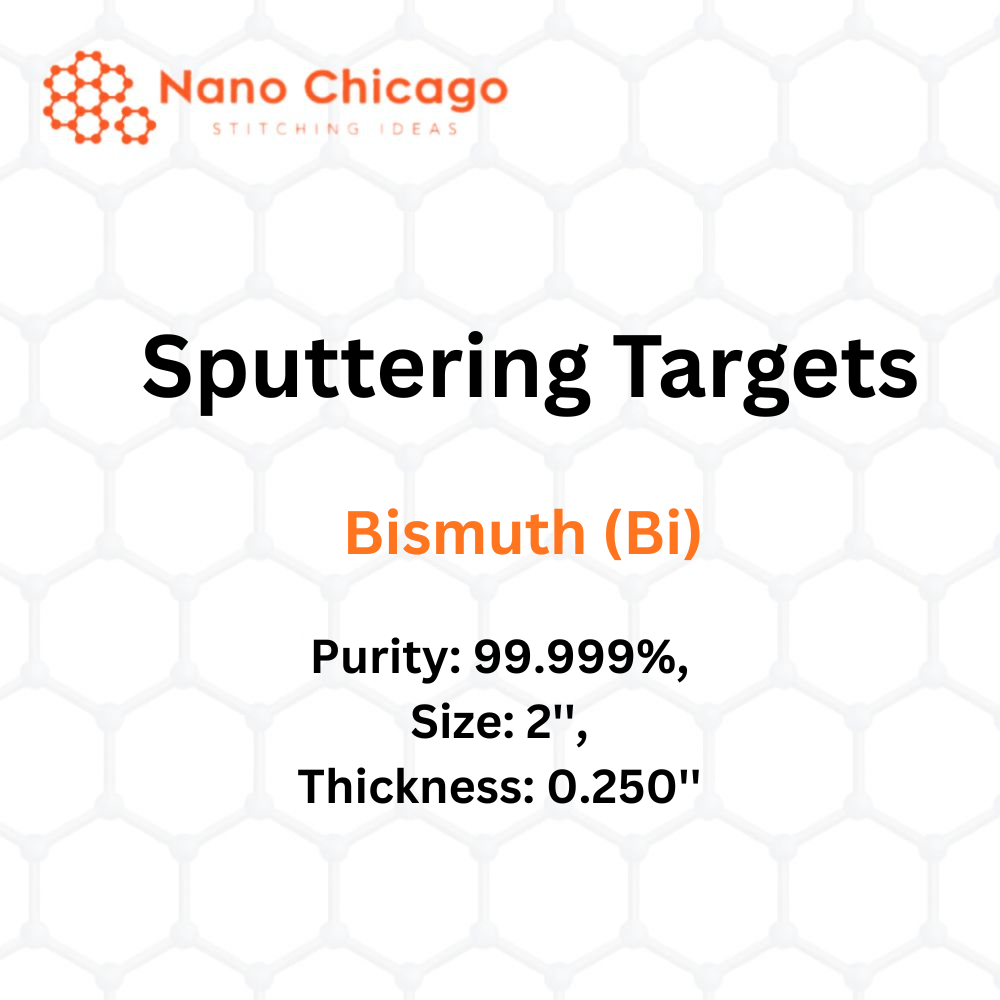
Bismuth (Bi) Sputtering Targets
Purity: 99.999% Size: 2” Thickness: 0.250”
Sputtering is a reliable and scalable technique for depositing thin films from various materials onto substrates of different shapes and sizes. The process allows chemical reactions to occur on the target surface, in-flight, or on the substrate depending on process conditions, offering precise control over film growth and microstructure.
Applications of Sputtering Targets
-
Thin Film Deposition: Transfers material from a target onto substrates like silicon wafers.
-
Semiconductor Etching: Provides high etching anisotropy where selectivity is not a primary concern.
-
Material Analysis: Supports techniques such as Secondary Ion Mass Spectroscopy (SIMS) for detecting composition and trace impurities.
-
Space Applications: Contributes to space weathering, affecting airless bodies like asteroids and the Moon.
About Bismuth (Bi)
Bismuth is a brittle, silvery-pink metal stable in air and water. Despite low thermal and electrical conductivity, it is used in:
-
Fusible Alloys & Thermal Fuses: Low-melting materials for solders and fuses.
-
Radiation Shielding: High gamma-ray absorption for filters or windows while allowing neutrons to pass.
-
Thermoelectric & Magnetoresistive Devices: Useful in thermoelectric conversion, magneto-resistance devices, and heavy metal detection electrodes.
-
Thin Film Semiconductors: Bi films transform into semiconductors at ~30 nm thickness, deposited via DC/RF sputtering, pulsed laser deposition, or thermal evaporation.
Deposition parameters—substrate temperature, target potential, ion beam energy, and energy release rate—affect Bi film crystalline structure and morphology. Applying positive pulses during DC sputtering enhances film density and mechanical properties.