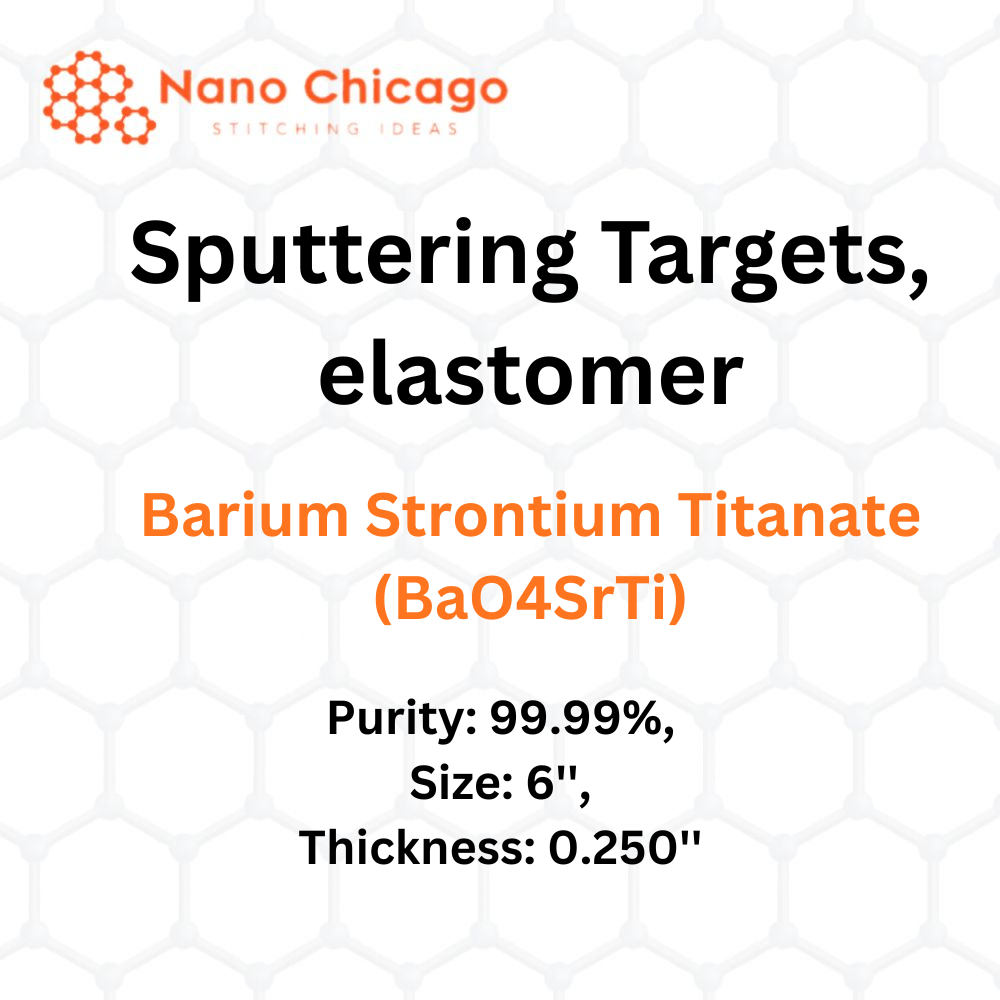
Barium Strontium Titanate (BaO₄SrTi) Sputtering Targets – Elastomer
Purity: 99.99% Size: 6” Thickness: 0.250”
Barium Strontium Titanate (BST) sputtering targets are designed for high-quality thin-film deposition across a wide range of substrates. Sputtering enables controlled material transfer from the target to the substrate, with reactions occurring on the target surface, during transport, or on the substrate itself. The process is repeatable, scalable, and adaptable for research environments as well as medium and large production batches. Its many adjustable parameters give experts precise control over film microstructure and growth characteristics.
Applications of Sputtering Targets
-
Thin Film Deposition: Coating substrates such as silicon wafers through material erosion from the target.
-
Semiconductor Etching: Used for processes requiring high anisotropy when selectivity is less critical.
-
Analytical Techniques (SIMS): Enables sputter-based compositional analysis and detection of trace impurities.
-
Space Research: Used to simulate space weathering effects on airless bodies like asteroids and the Moon.
BST Material Characteristics
Barium Strontium Titanate (BST) is a solid solution derived from BaTiO₃ and SrTiO₃. Thin films produced through sputtering offer excellent dielectric properties, making BST a key material in tunable ferroelectric devices. Over the last decade, BST-based thin-film components have gained prominence in:
-
Tunable microwave devices
-
Delay lines
-
Resonators
-
Phase shifters
-
Varactors
BST thin films are valued for their high dielectric constant, strong tunability, and low dielectric loss. Their performance depends on variables such as:
-
Oxygen vacancies
-
Film thickness
-
Grain size
-
Ba/Sr composition ratio
-
Doping levels
-
High-temperature annealing
-
Multilayer structure design
Extensive research continues to refine BST films for enhanced device efficiency and lower energy losses.