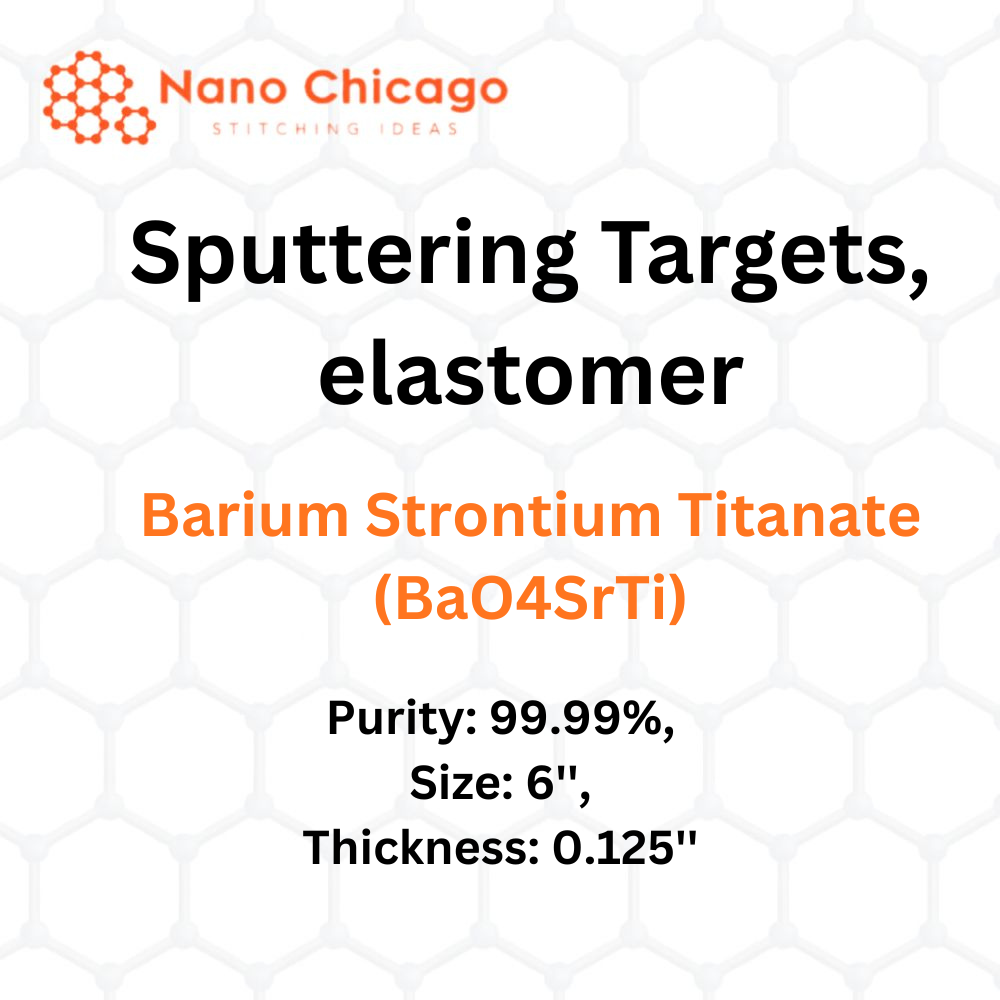
Barium Strontium Titanate (BaO₄SrTi) Sputtering Targets – Elastomer Backing
Purity: 99.99% | Size: 6” | Thickness: 0.125”
Overview
Barium Strontium Titanate (BST) sputtering targets are high-purity ceramic materials used for precision thin-film deposition. Sputtering is a proven technique capable of depositing thin films onto a wide range of substrate shapes and sizes. The process is repeatable, scalable from small R&D projects to medium and large production batches, and offers excellent control over film growth and microstructure.
Chemical reactions during deposition may occur on the target surface, in-flight, or directly on the substrate, depending on the selected process parameters. Although sputtering is a complex method with many variables, it provides experts with strong control over the final film properties.
Applications of Sputtering Targets
Thin Film Deposition
Sputtering targets are widely used to deposit thin films by eroding material from the target and transferring it onto a substrate such as a silicon wafer.
Semiconductor Etching
In semiconductor applications, sputter etching is used when high anisotropy is required and etching selectivity is not critical.
Material Analysis
Sputtering allows precise analysis of materials by controlled removal of surface layers.
A common example is Secondary Ion Mass Spectrometry (SIMS), where the target is sputtered at a constant rate. As atoms are removed, their identity and concentration are measured using mass spectrometry, enabling detection of extremely low impurity levels.
Space and Planetary Science
Sputtering is also a natural process in space weathering, where micrometeoroids and solar wind particles alter the physical and chemical properties of airless bodies such as asteroids and the Moon. BST targets help replicate these conditions in laboratory environments.
Material: Barium Strontium Titanate (BST)
BST is a solid solution of barium titanate (BaTiO₃) and strontium titanate (SrTiO₃). Thin films produced using sputtering techniques exhibit excellent dielectric behavior and are widely used in advanced electronic, RF, and microwave devices.
Key Advantages of BST Thin Films
-
High dielectric constant
-
Strong electric-field tunability
-
Low dielectric loss
-
Ferroelectric properties ideal for functional devices
-
Stable performance at microwave frequencies
These properties make BST thin films suitable for various tunable microwave components, including:
-
Delay lines
-
Resonators
-
Phase shifters
-
Varactors
Performance Factors of BST Films
Studies have shown that the dielectric and tunable properties of BST films depend on several parameters, including:
-
Oxygen vacancy concentration
-
Film thickness
-
Grain size
-
Ba/Sr ratio
-
Doping concentrations
-
High-temperature annealing conditions
-
Use of multilayer structures
By optimizing these parameters, researchers can achieve higher dielectric tunability and lower dielectric loss for specialized electronic applications.