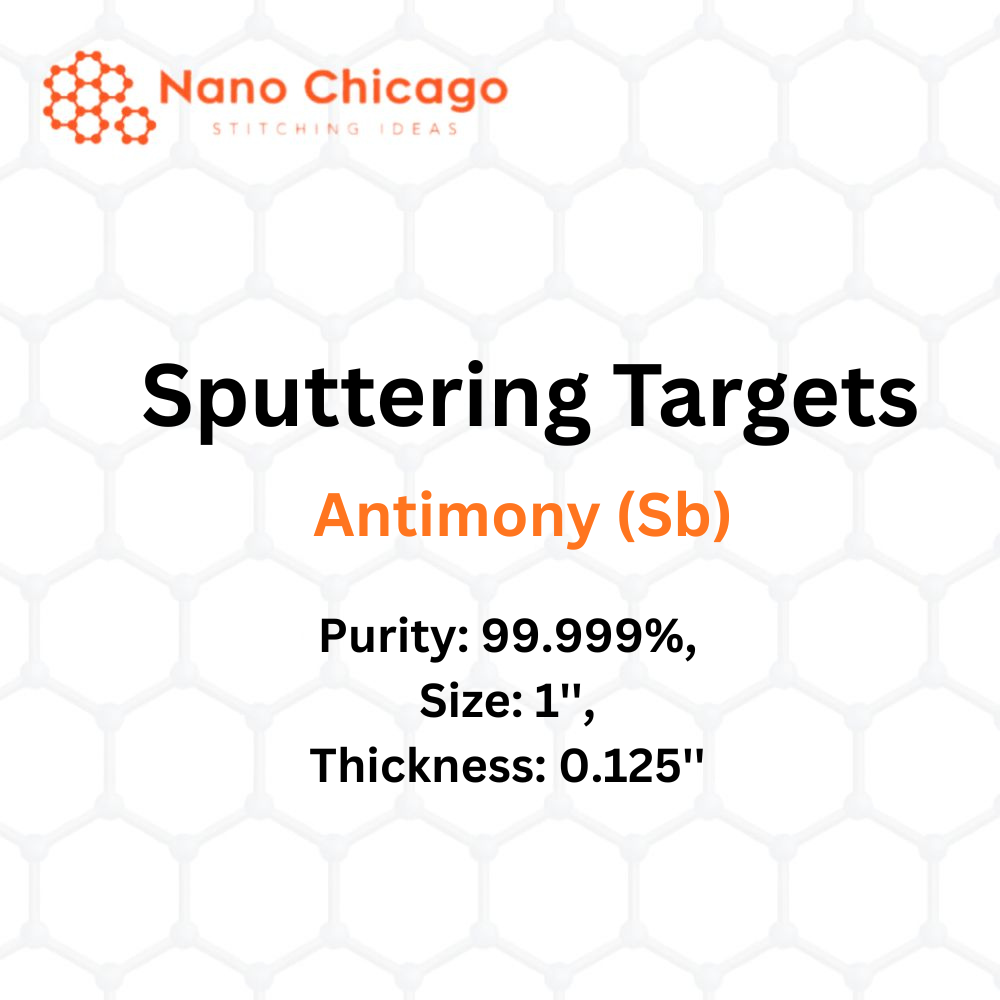
Antimony (Sb) Sputtering Targets
Purity: 99.999% Size: 1” Thickness: 0.125”
Antimony sputtering targets are designed for reliable, high-precision thin-film deposition on a wide range of substrate shapes and sizes. Sputtering is a well-established, repeatable, and scalable technique, suitable for small research applications as well as medium-to-large production batches. Depending on the process settings, chemical reactions may occur on the target surface, during particle transit, or on the substrate itself—providing experts substantial control over film composition, growth behavior, and microstructure.
Applications
-
Thin-Film Deposition:
Used to transfer material from the antimony target onto substrates such as silicon wafers through controlled erosion of the target surface. -
Semiconductor Processing:
Employed in sputter etching where high anisotropy is required and selectivity is not a key constraint. -
Analytical Techniques (SIMS):
In secondary ion mass spectrometry, the sample is sputtered at a constant rate, allowing precise measurement of emitted ions. This enables accurate determination of composition and detection of extremely low impurity concentrations. -
Space Science & Planetary Weathering:
Sputtering contributes to space weathering processes that modify the physical and chemical characteristics of airless bodies such as asteroids and the Moon.
About Antimony (Sb)
Antimony (atomic number 51) is a bluish-white metalloid in group 15, closely related to arsenic and bismuth in chemical behavior but without arsenic’s strong toxicity profile. Its average crustal abundance ranges from 0.2 to 0.5 ppm.
Antimony exhibits excellent fire-retardant properties, making Sb sputtering targets suitable for fire-resistant coating applications. They are also used in a range of optoelectronic devices including LEDs, laser diodes, photodiodes, and solar cells.
In semiconductor technologies, antimony serves as a dopant in n-type silicon wafers used for diodes, infrared detectors, and Hall-effect devices. Sb can also form specialized alloys and compounds with other elements, such as tin. When combined with indium, antimony produces materials such as indium antimony oxide, which is used as a sputtering agent for transparent conductive films.