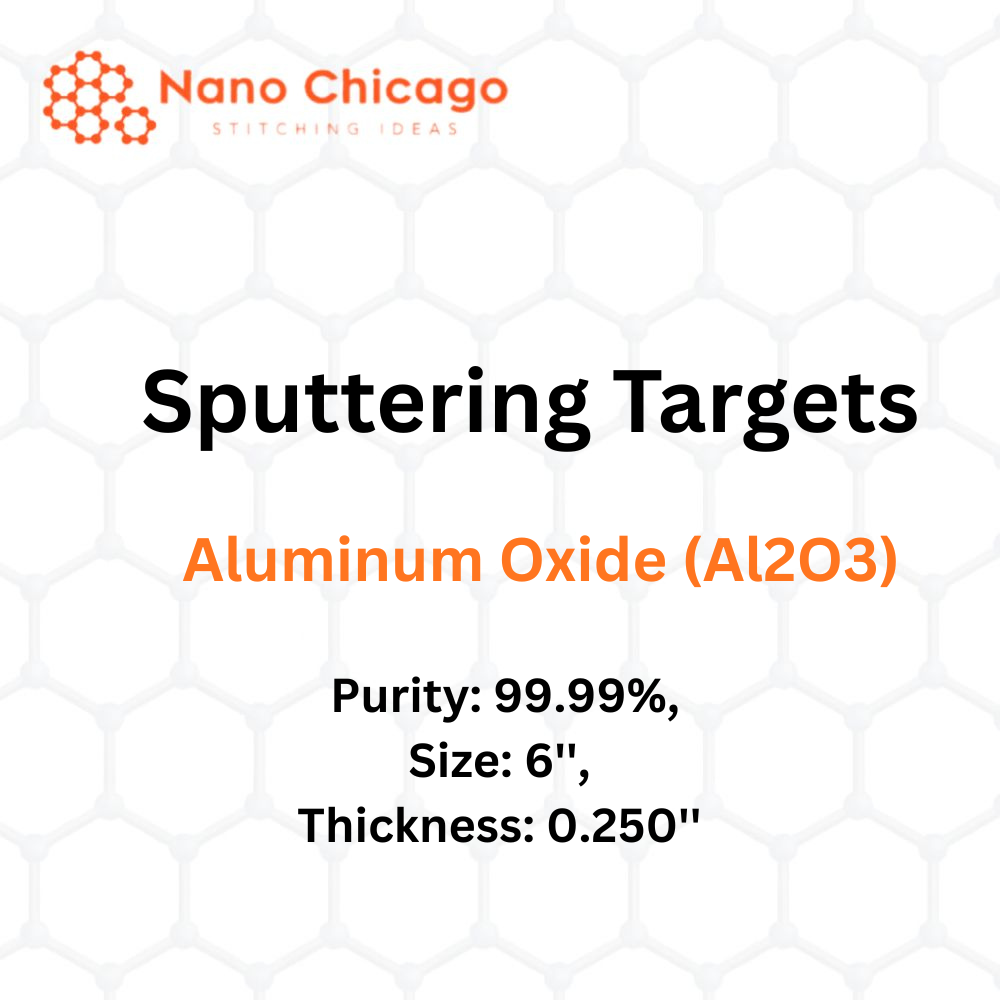
Aluminum Oxide (Al₂O₃) Sputtering Targets
Purity: 99.99% Size: 6” Thickness: 0.250”
Sputtering is a well-established technique used to deposit thin films from a wide range of materials onto substrates of different shapes and sizes. The sputtering process is highly repeatable and can be scaled from small R&D projects to medium- and large-scale production batches. Depending on the process conditions, chemical reactions can occur on the target surface, during particle flight, or directly on the substrate. Although sputtering involves many variables—making it a complex process—it allows experts significant control over the film’s growth behavior and microstructure.
Applications of Sputtering Targets
Thin-Film Deposition:
Sputtering targets are primarily used for thin-film deposition by eroding material from a “target” and transferring it onto a substrate such as a silicon wafer.
Semiconductor Processing:
Sputtering targets are also used in sputter etching when high anisotropy is required and selectivity is not a major concern.
Material Analysis:
Targets are used in analytical techniques such as Secondary Ion Mass Spectrometry (SIMS). In SIMS, the sample is sputtered at a constant rate, and the ejected atoms are analyzed to determine elemental composition—down to extremely low impurity levels.
Space Science:
Sputtering contributes to space weathering, a process that alters the chemical and physical properties of airless bodies like asteroids and the Moon.
About Aluminum Oxide (Al₂O₃)
Aluminum oxide is a compound of aluminum and oxygen, valued for its hardness, high melting point, and chemical stability. It is widely used for producing aluminum metal, as an abrasive, and as a refractory material.
Thin films produced using aluminum oxide sputtering targets are extensively applied in mechanical, optical, and microelectronic fields due to their:
-
High mechanical strength and hardness
-
Optical transparency
-
Excellent abrasion and corrosion resistance
-
Strong insulating and dielectric properties
These film properties depend heavily on sputtering parameters such as deposition rate, target-substrate distance, and reactive gas pressures.
Applications of Aluminum Oxide Thin Films
Al₂O₃ thin films are widely used in:
-
Optoelectronics
-
Tribology and wear-resistant surfaces
-
Sensors and microdevices
-
Nanolithography
-
Coatings and protective barriers
They can be deposited using techniques such as magnetron sputtering, atomic layer deposition (ALD), electron-beam evaporation, spray pyrolysis, and oxidation of aluminum films.
Summary
Aluminum oxide (Al₂O₃) is known for its chemical inertness, mechanical durability, corrosion and abrasion resistance, high dielectric constant, and strong electrical breakdown field. Because of these properties, Al₂O₃ thin films produced by sputtering targets continue to gain global interest across research and industrial applications—including protective coatings, diffusion barriers, electronic seals, dielectric layers, optical coatings, and more.