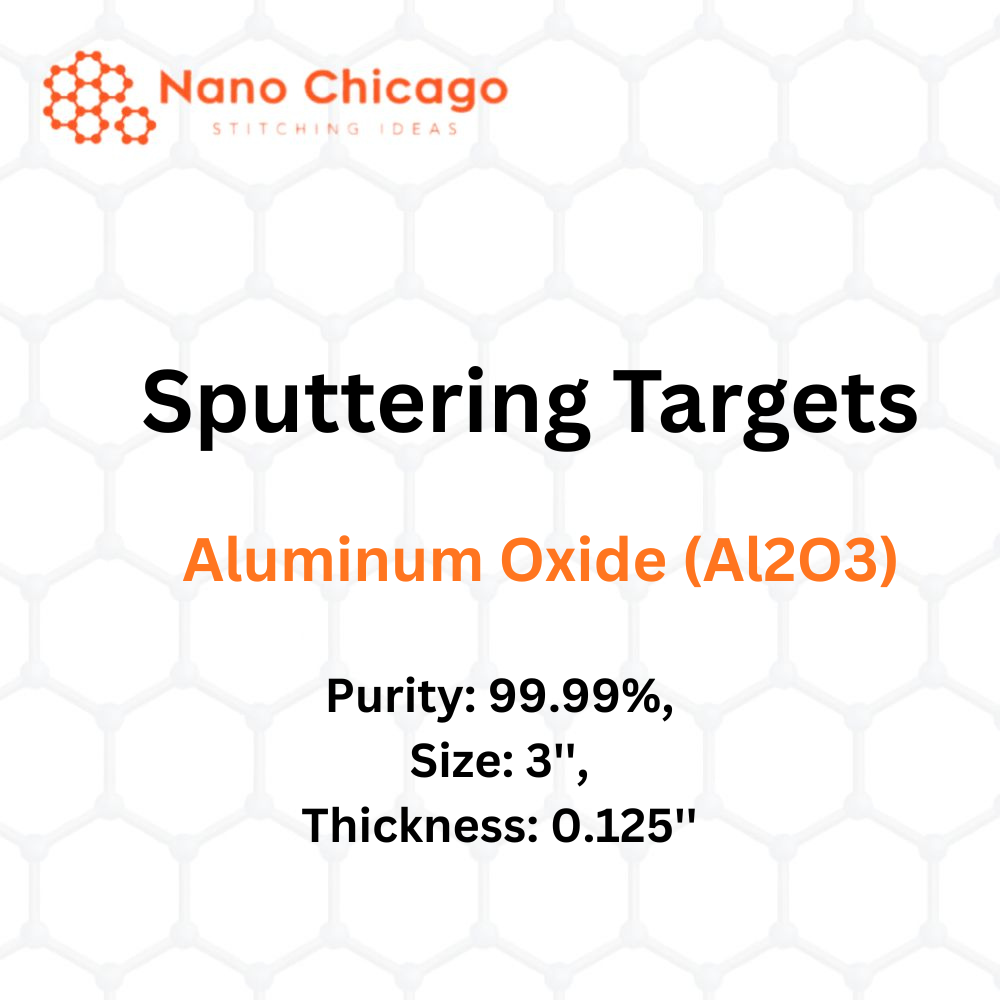
Aluminum Oxide (Al2O3) Sputtering Targets
Purity: 99.99%, Size: 3”, Thickness: 0.125”
Sputtering is a proven technology capable of depositing thin films from a wide range of materials onto diverse substrate shapes and sizes. The process using sputter targets is repeatable and can be scaled up from small research and development projects to medium and large substrate areas. Chemical reactions may occur on the target surface, in-flight, or on the substrate depending on the process parameters. Although sputter deposition involves many variables, these parameters provide experts with significant control over film growth and microstructure.
Applications of Sputtering Targets
Sputtering targets are used for film deposition. The deposition achieved using sputter targets involves eroding material from a “target” source onto a “substrate” such as a silicon wafer. Semiconductor sputtering targets are used for etching when a high degree of etching anisotropy is required and selectivity is not a primary concern.
Sputtering targets are also used for analytical purposes by etching away the target material. One example is secondary ion spectroscopy (SIMS), where the target sample is sputtered at a constant rate. As sputtering progresses, the concentration and identity of sputtered atoms are measured using mass spectrometry. Through this process, the composition of the target material can be determined, including extremely low concentrations of impurities.
Sputtering targets also have applications in space. Sputtering is a form of space weathering, a process that alters the physical and chemical properties of airless bodies such as asteroids and the Moon.
Aluminum oxide is a chemical compound of aluminium and oxygen with the formula Al2O3. It is widely used in producing aluminium metal, as an abrasive due to its hardness, and as a refractory material because of its high melting point. Aluminum oxide thin films produced using aluminum oxide sputtering targets are utilized in mechanical, optical, and microelectronic applications owing to their excellent mechanical strength and hardness, transparency, high abrasion and corrosion resistance, and insulating and optical properties. These film properties depend on sputtering parameters such as sputtering rate, target–substrate distance, and reactive gas pressures.
Aluminum oxide thin films used in optoelectronics, tribology, sensorics, and nanolithography have been deposited through techniques such as magnetron sputtering, atomic layer deposition, electron beam evaporation, spray pyrolysis, and oxidation of aluminum films.
Summary
Al2O3 has unique properties including chemical inertness, mechanical strength and hardness, high abrasion and corrosion resistance, a high electrical breakdown field, and a high dielectric constant. Thin films produced using aluminum oxide sputtering targets have attracted increasing attention from researchers worldwide. These targets are used in various mechanical and microelectrical applications such as protective coatings, diffusion barriers, electronic seals, dielectric layers, optical layers, and more.