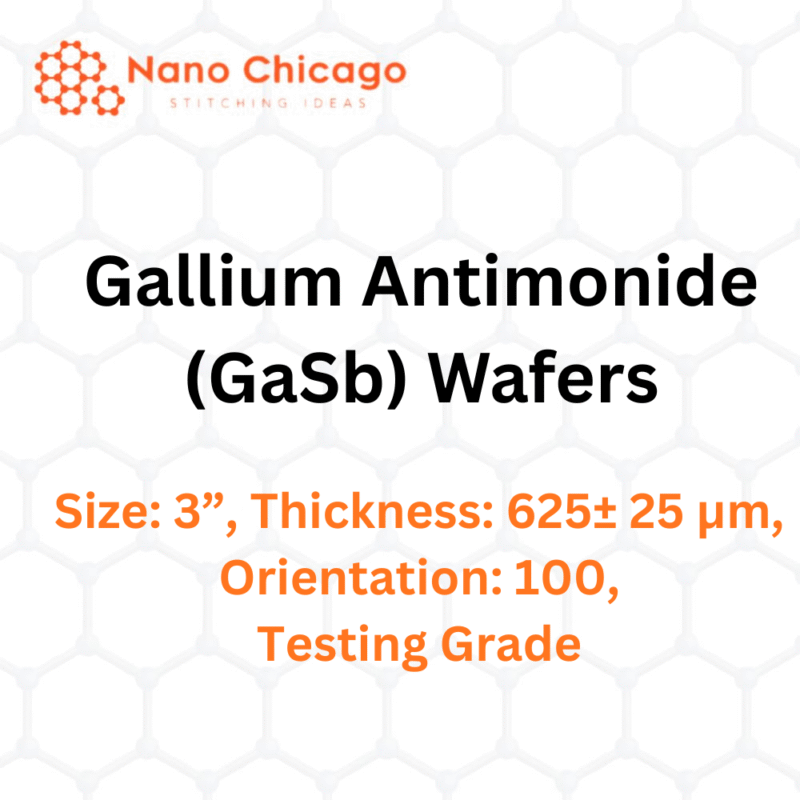
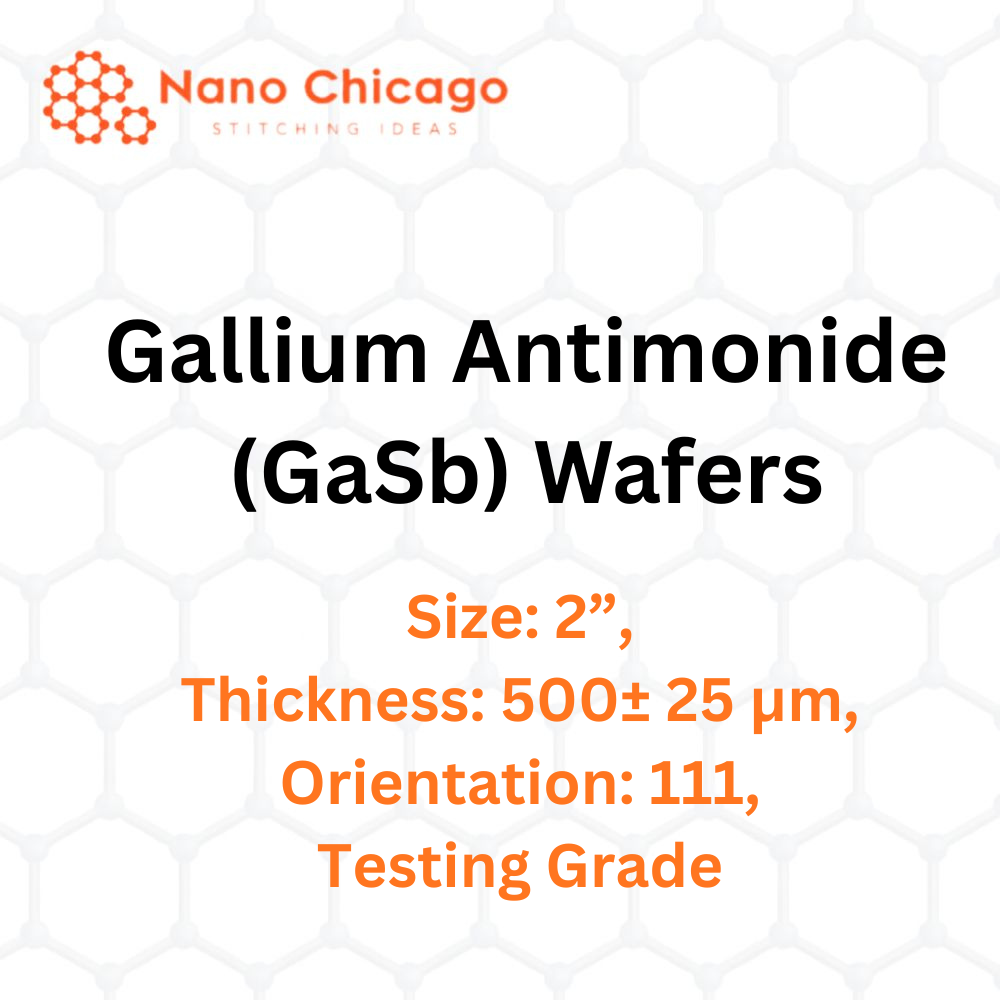
Gallium Antimonide (GaSb) Wafers
Size: 2”, Thickness: 500± 25 μm, Orientation: 111
Technical Properties:
| Property | Value |
|---|---|
| Quality | Testing Grade |
| Size (inch) | 2” |
| Thickness (μm) | 500± 25 |
| Polished | Single Side |
| Dopant | Tellurium (N type) |
| Orientation | 111 |
| Mobility | 2000–3500 |
| EPD | ≤2000 |
| Growth method | VGF |
| OF Length | 16±2 |
| IF Length | 8±1 |
Fields of Application for Gallium Antimonide (GaSb)
The intermetallic compound gallium antimonide (GaSb) was first synthesized in 1926 by Victor Goldschmidt.
Gallium antimonide (GaSb) is a semiconductor composed of gallium and antimony, classified as a III-V compound.
Gallium antimonide (GaSb) is provided in polished wafer form.
Gallium antimonide (GaSb) wafers are produced from polycrystalline ingots using the Czochralski method to achieve a highly pure single crystal.
Supplied as polished wafers, gallium antimonide offers excellent orientation accuracy.
The thickness and orientation of these wafers can be adjusted with specific additives.
The Czochralski method ensures high-purity growth of gallium and antimony elements.
The naturally low-defect structure of GaSb makes it ideal for epitaxial growth.
They are available polished on one or both sides and can be supplied in cut forms.
Gallium antimonide (GaSb) is used for infrared detectors.
Gallium antimonide (GaSb) is used for infrared LEDs.
Gallium antimonide (GaSb) is used for transistors.
Gallium antimonide (GaSb) is used for lasers.
Gallium antimonide (GaSb) is used for thermophotovoltaic systems.