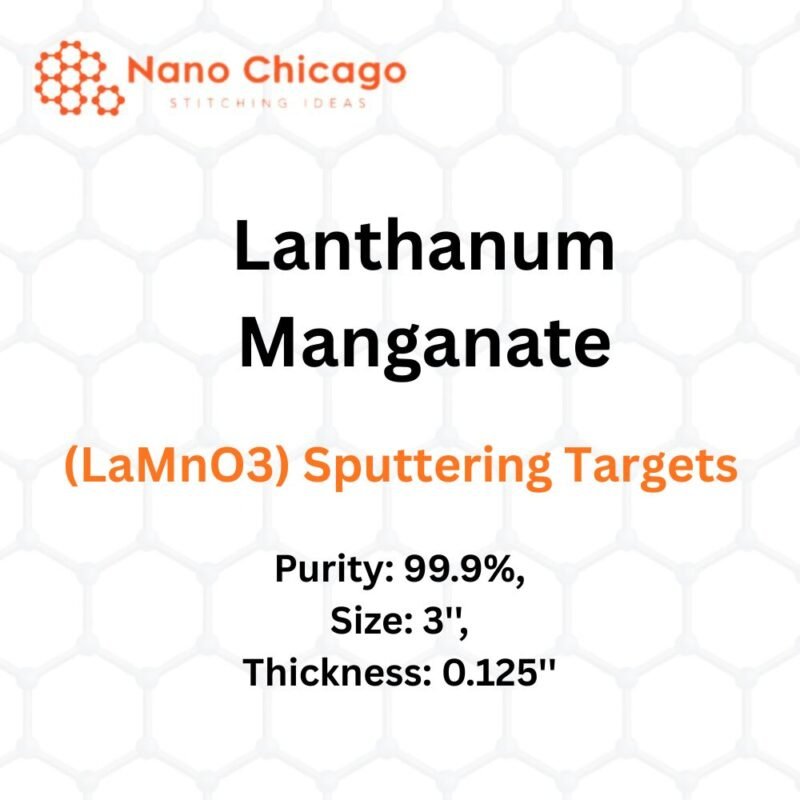
Lanthanum Manganate (LaMnO3) Sputtering Targets
Product Specifications
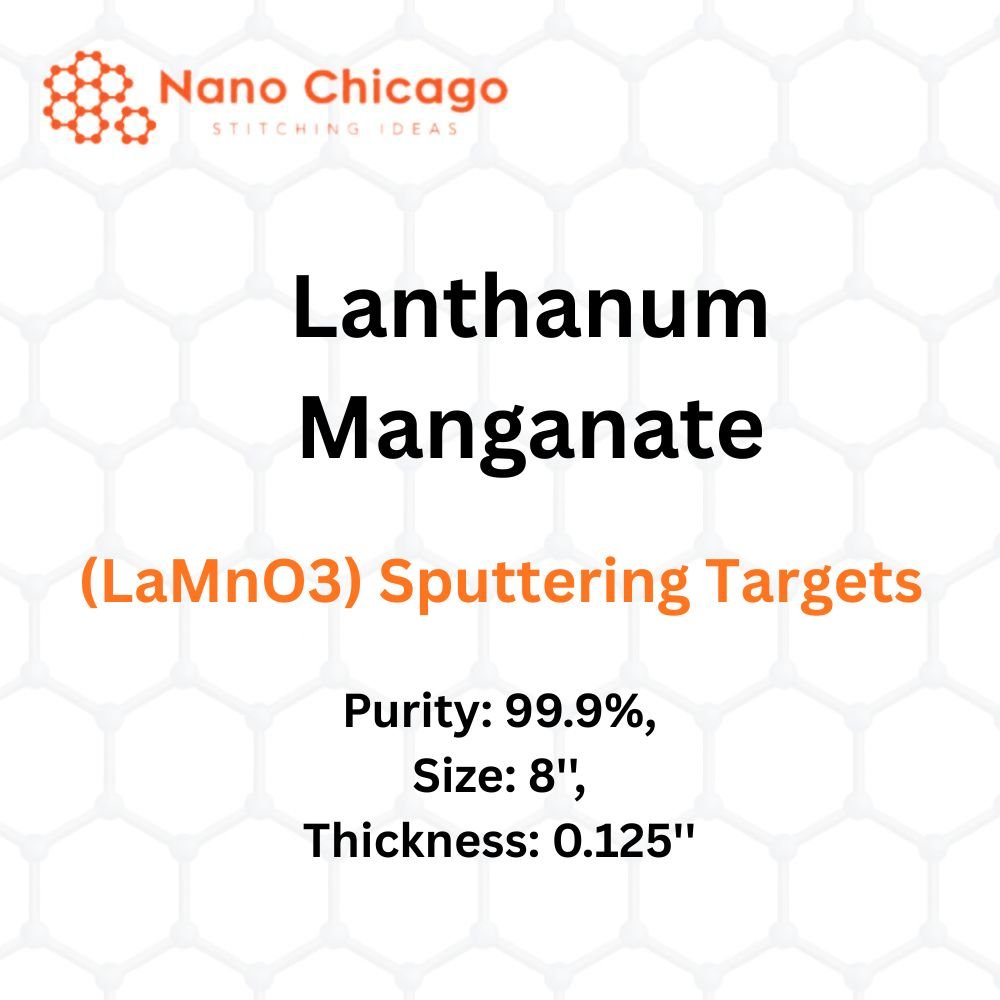
| Property | Value |
|---|---|
| Product | Lanthanum Manganate (LaMnO3) Sputtering Targets |
| Purity | 99.9% |
| Size | 8” |
| Thickness | 0.125” |
Overview
Sputtering is a well-established technique capable of depositing thin films from a wide variety of materials onto diverse substrate shapes and sizes. The process using sputtering targets is repeatable and can be scaled from small research and development projects to production batches involving medium to large substrate areas. Chemical reactions may occur on the target surface, during transport, or on the substrate depending on process parameters. While sputter deposition involves many variables, these parameters provide experts with a high degree of control over film growth and microstructure.
Applications of Sputtering Targets
Sputtering targets are used for thin-film deposition. This process involves eroding material from a “target” source onto a “substrate,” such as a silicon wafer. Semiconductor sputtering targets are also used for etching, particularly when high etching anisotropy is required and selectivity is not a concern. Sputtering targets are additionally employed for analytical applications to remove target material.
A key example is secondary ion mass spectrometry (SIMS), where the target is sputtered at a constant rate. As material is removed, the concentration and identity of sputtered atoms are measured using mass spectrometry. This allows determination of target composition and detection of extremely low concentrations of impurities.
Sputtering also has applications in space. It is one of the mechanisms of space weathering, a process that alters the physical and chemical properties of airless bodies such as asteroids and the Moon.