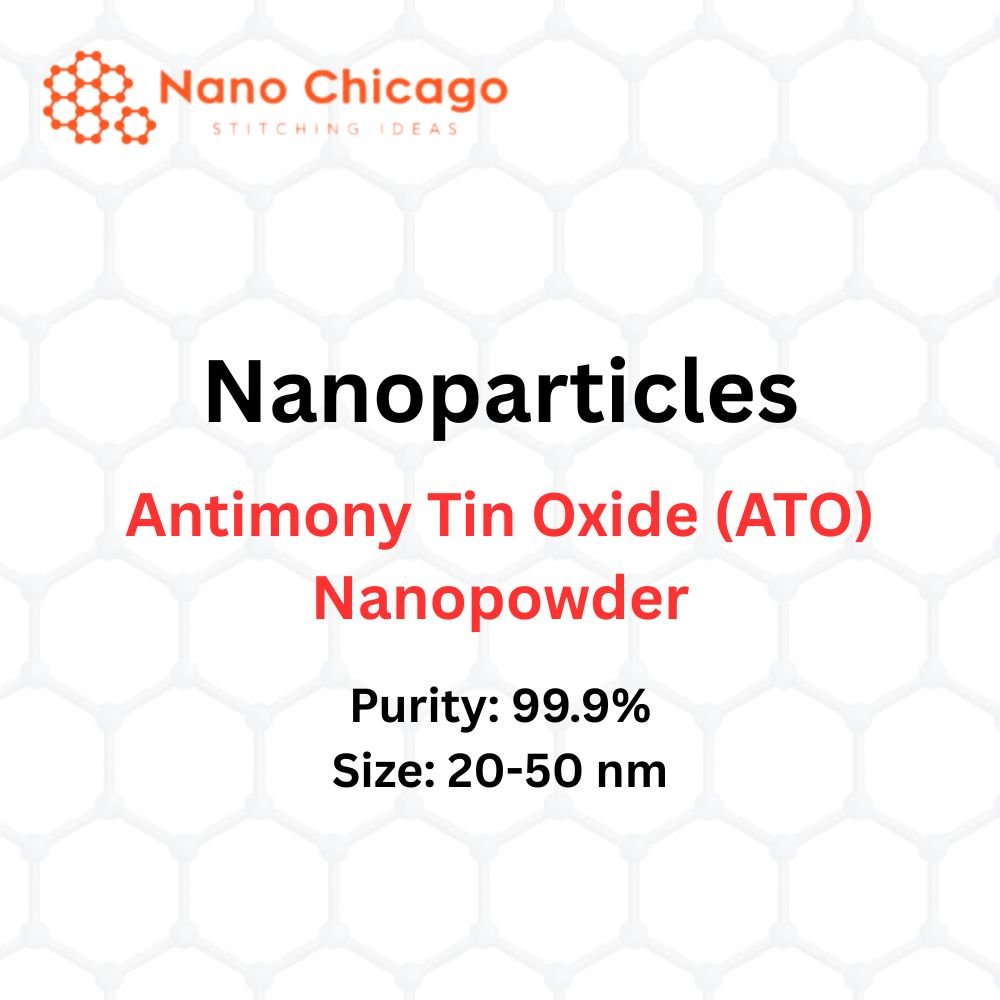
Antimony Tin Oxide (ATO) Nanopowder/Nanoparticles
Purity: 99.9%, Size: 20–50 nm, SnO₂:Sb₂O₃ = 90:10
Technical Properties
| Property | Value |
|---|---|
| Purity (%) | 99.9 |
| Bulk Density (g/cm³) | ≤0.95 |
| Color | light blue |
| Average Particle Size (nm) | 20–50 |
| Electrical Conductivity (Ω) | 108 |
| Resistivity (Ω·cm) | 50 |
| Heat Resistance (°C) | 1100 |
| Specific Surface Area (m²/g) | >95 |
| Loss in Drying (%) | 0.5 |
| pH | 4.0–7.0 |
| Elemental Analysis | As: <2 ppm, Cd: <2 ppm, Pb: <32 ppm, Ni: <5 ppm, Bi: <9 ppm, Zn: <5 ppm, K: <7 ppm, Al: <2 ppm, Cu: <28 ppm, Ag: <2 ppm, Fe: <19 ppm, In: <8 ppm |
Applications
Antimony Tin Oxide nanoparticles exhibit excellent electrical and optical properties. They are used in optoelectronic display devices and flat panel displays such as LED, LCD, and ECD. They are also applied in solar batteries and transparent electrodes.
Their high electrical conductivity makes them suitable for coatings, chemical fibers, and polymeric membranes as anti-static materials. ATO nanoparticles also have high heat resistance and can be used for heat shielding in buildings or glass, as well as in hot mirrors. They are applied in automotive and aircraft glass for fog and frost protection.
Additionally, Antimony Tin Oxide nanoparticles can attenuate microwaves, making them useful for electromagnetic wave shielding in environments such as computer rooms and radar installations.