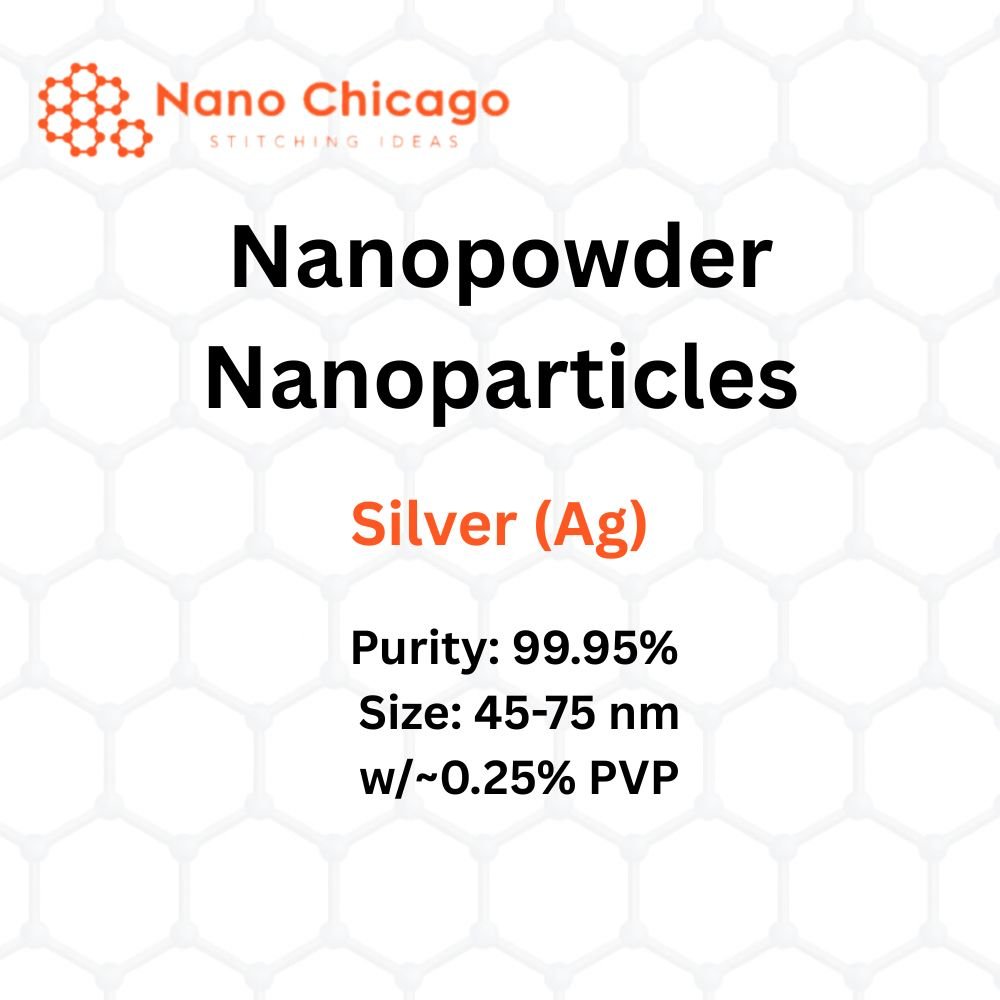
Silver (Ag) Nanopowder/Nanoparticles
Purity: 99.95% Size: 45–75 nm with ~0.25% PVP
Silver has been widely recognized for its antimicrobial properties for centuries, and in nanopowder form its high surface area significantly enhances its effectiveness. Silver nanopowders are versatile materials with numerous potential applications due to their electrical, optical, and catalytic properties.
The PVP (polyvinylpyrrolidone) coating provides additional advantages:
-
Enhances nanoparticle stability
-
Reduces aggregation during storage
-
Improves dispersibility in solvents and polymer matrices
-
Expands compatibility with a wider range of application environments
Nanografi supplies silver nanopowders in multiple sizes and purities to support diverse industrial, scientific, and technological needs.
Technical Properties of Silver Nanoparticles
| Property | Value |
|---|---|
| True Density (g/cm³) | 10.6 |
| Color | black |
| Shape | spherical |
| Crystal Structure | cubic |
| Atomic Weight | 107.87 |
| T<sub>melting</sub> (°C) | 961.9 |
| T<sub>boiling</sub> (°C) | 2212 |
| Average Particle Size (nm) | 45–75 |
Elemental Analysis
| Ag | Cu | Fe | Bi, Pb, Sb |
|---|---|---|---|
| ≥99.95 | ≤0.010 | ≤0.003 | ≤0.002 |
Applications of Silver Nanoparticles
Silver nanoparticles are widely known for their powerful antimicrobial, antibacterial, and disinfectant properties. Even small additions (~0.1%) to inorganic matrices significantly enhance resistance to bacteria such as Escherichia coli and Staphylococcus aureus. These antimicrobial effects are stable across varying pH levels and oxidation conditions.
Additional application areas include:
-
Catalysis: Effective in reactions like ethylene oxidation, improving reaction speed and efficiency.
-
Biological & Diagnostic Research: Used in gene diagnostics, biosensors, and medical assays due to their optical response and high biocompatibility.
-
Electronics & Photonics: Utilized for conductive inks, coatings, photonic components, and plasmonic applications.
-
Consumer & Household Products: Incorporated into antimicrobial consumer goods such as washing machines, refrigerators, textiles, toys, food containers, and detergents.
-
Construction Materials: Added to paints and coatings to impart antibacterial and corrosion-resistant properties.