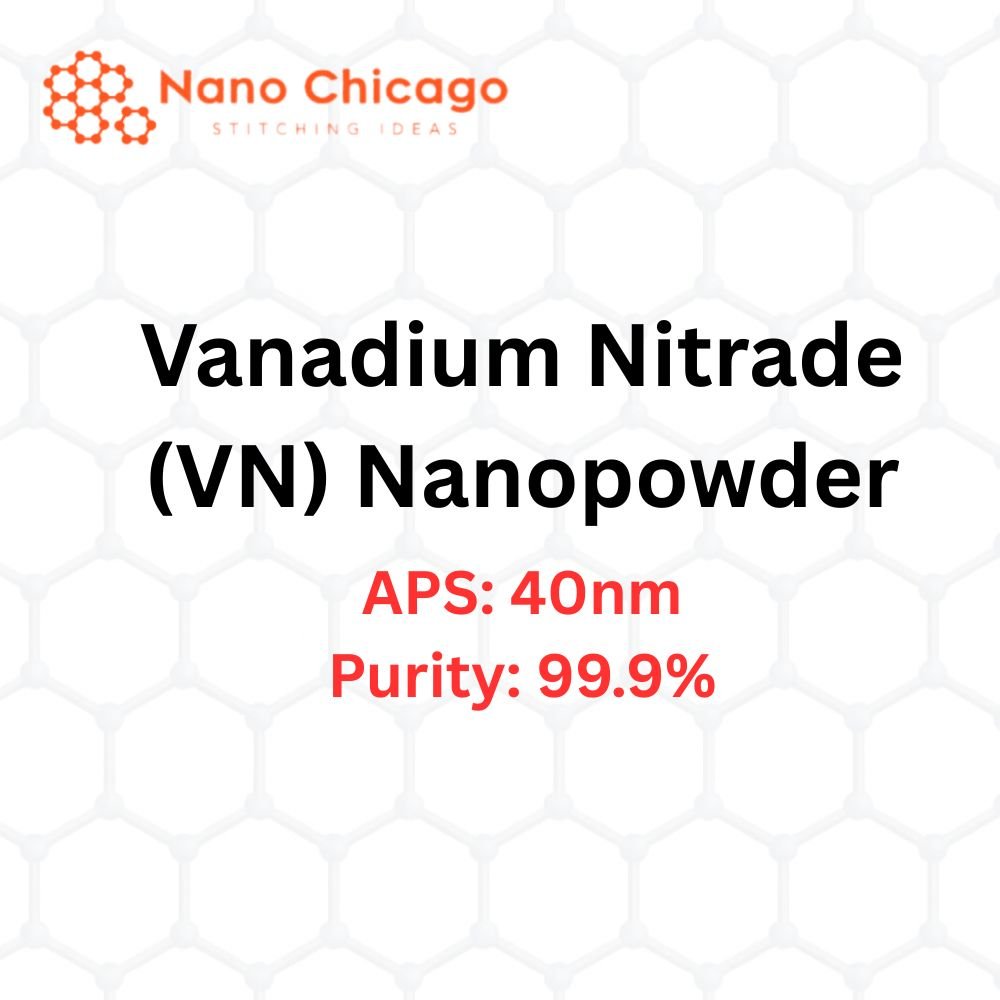
Vanadium Nitride (VN) Nanopowder
APS: 40 nm, Purity: 99.9%
Performance Characteristics
Nano vanadium nitride powder is prepared by high-frequency plasma gas-phase synthesis. It has high purity, no free carbon black dot impurities, no ammonium chloride impurities, uniform particle size distribution, and is suitable for large-scale production. It can be applied in cemented carbide in large quantities. Its surface activity allows good dispersion in alloy materials, providing alloy dispersion strengthening. Vanadium nitride, also known as a vanadium-nitrogen alloy, is a new type of alloy additive that can replace ferro-vanadium in microalloyed steel production. The addition of vanadium nitride improves steel’s comprehensive mechanical properties, including strength, toughness, ductility, and thermal fatigue resistance, while maintaining good weldability. At the same strength, adding nano-vanadium nitride can reduce vanadium usage by 30-40%, lowering costs.
Product Parameter
| APS | 40 nm | ||
|---|---|---|---|
| Purity | 99.9 % | ||
| BET Surface Area | 56.26 m2/g | ||
| Theoretical Density | 6.135 g/cm3 | ||
| Bulk Density | 0.710 g/cm3 | ||
| Melting Point | 1600 °C | ||
| Boiling Point | 2500 °C | ||
| Shape | Cubic | ||
| Color | Black | ||
| Manufacturing Method | CVD |
Applications
Vanadium-nitrogen alloy can be used in structural steel, tool steel, pipe steel, steel bars, and cast iron. In high-strength low-alloy steel, it promotes the precipitation of carbon, vanadium, and nitrogen compounds, enhancing settlement strengthening and grain refinement.
Nano-vanadium nitride (VN) exhibits high thermal and chemical stability and strong mechanical properties. It is widely used in cutting tools, abrasive tools, and structural materials. VN also serves as an efficient catalyst with high catalytic activity, selectivity, stability, and anti-poisoning performance. Fine-grained VN improves catalytic activity and enhances the toughness of structural materials.
Packaging and Storage
This product is packaged in an inert gas plastic bag, sealed, and stored in a dry, cool environment. It should not be exposed to air to prevent oxidation and agglomeration due to moisture, which can affect dispersion performance and effectiveness. Packaging quantities can be customized according to customer requirements.