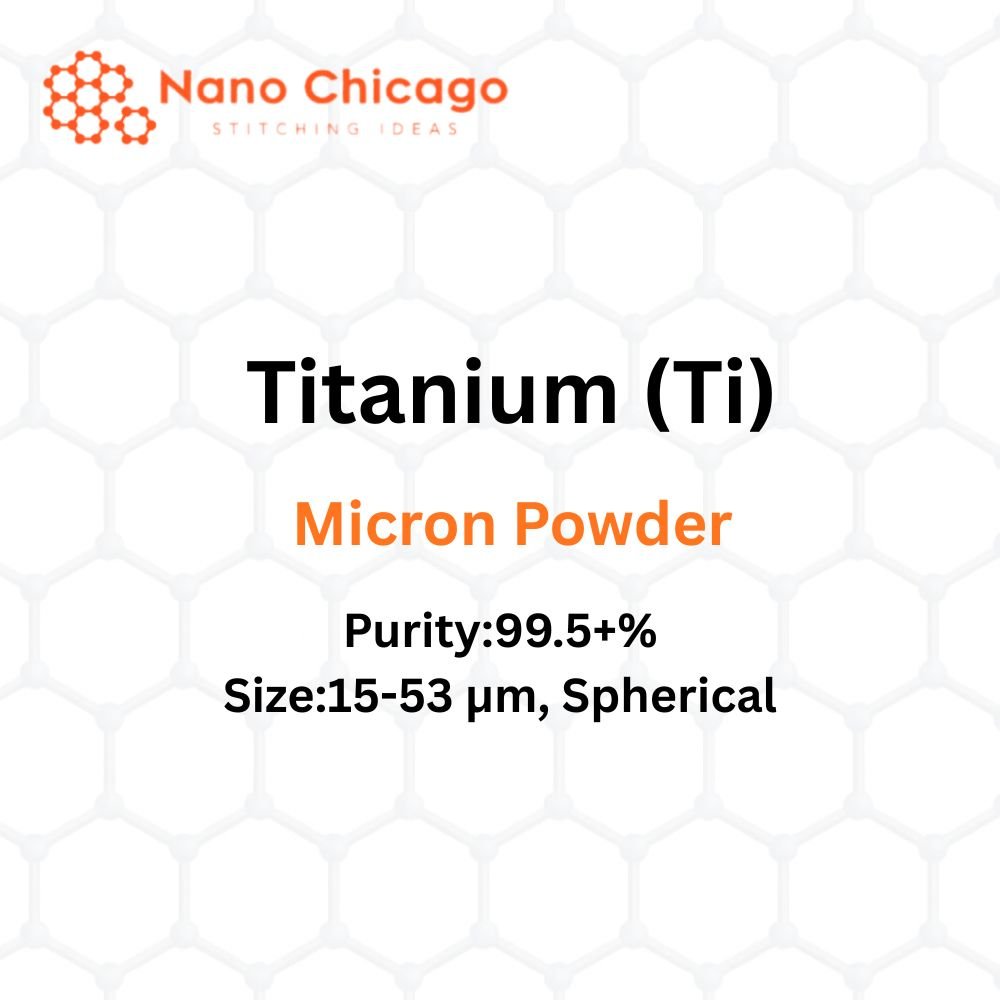
Titanium (Ti) Micron Powder
Purity: 99.5+%, Size: 15–53 µm
Titanium is recognized for its high strength-to-weight ratio, making it a widely used material across many applications. It provides excellent resistance to corrosion, allowing it to perform well in harsh chemical environments. Titanium is also biocompatible, enabling its use in medical implants and devices. Titanium micron powder is additionally used as an opacifier and whitener in porcelain enamels, offering a high-gloss, acid-resistant finish with increased hardness.
Properties, Storage and Cautions
Titanium micron powder is highly reactive and flammable, requiring careful handling. Rapid movements and vibrations should be avoided. The powder must be protected from sunlight, heat, moisture, and impact. Because particle coagulation is a significant issue, it should be sealed under vacuum and stored in cool, dry conditions. Contact with air should also be minimized.
Technical Properties
| Property | Value |
|---|---|
| Purity | 99.5+% |
| Particle Size | 15–53 µm |
| CAS | 7440-32-6 |
| Melting Point | 1668 °C |
| Boiling Point | 3260 °C |
| Density | 4.507 g/cm³ |
| Form | Powder |
| COEFF. OF EXPANSION @ 20ºC | 8.5 x 10⁻⁶ |
| Electric Resistivity | 47.8 microhm-cm |
| Crystal Structure | Spherical |
Chemical Composition
| Element | Ti | Fe | Cr | Mo | Cu | As | Al |
|---|---|---|---|---|---|---|---|
| Value (%) | 99.5+ | <0.2 | <0.005 | <0.001 | <0.001 | <0.001 | <0.01 |
Applications
Titanium offers valuable characteristics such as UV resistance, biocompatibility, corrosion resistance, and high mechanical strength.
It is used in:
Aerospace machines,
Implants,
Electronic devices,
Nano-composites,
Optical materials,
Glass modification additives,
Micro and nano sensors, etc.