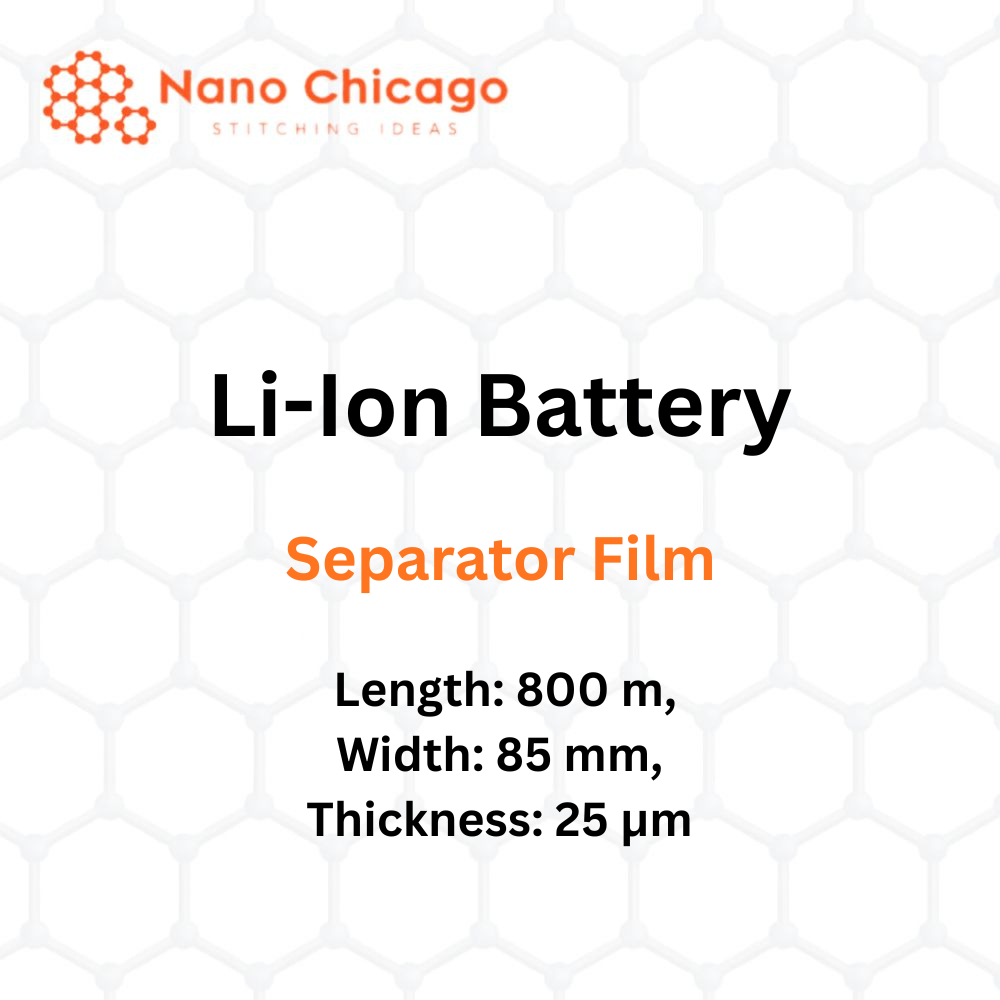
Li-Ion Battery Separator Film
Length: 800 m, Width: 85 mm, Thickness: 25 μm
Li-ion battery separators are critically important cell components that physically separate the anode and cathode to prevent internal short circuits, ensuring cell safety. These microporous membranes provide good mechanical properties and chemical stability. For applications requiring the highest uniformity, this Li-ion battery separator is offered at a competitive price.
Technical Properties
| Property | Specification |
|---|---|
| Thickness | 25 μm |
| Width | 85 mm |
| Length | 800 m |
| Gurley JIS | 620 seconds |
| TD Shrinkage @ 90°C / 1h | 0% |
| MD Shrinkage @ 90°C / 1h | 5% |
| Porosity | 39% |
| Pore Size | 0.21 × 0.05 μm |
| Puncture Strength | 380 g |
| Tensile Strength, MD | 1700 Kg/cm² |
| Tensile Strength, TD | 150 Kg/cm² |
Applications
It can be used as a Li-ion battery separator in battery R&D.
With the growing demand for electric energy storage systems, lithium-ion batteries remain the best option for applications requiring high energy density, cycle durability, and charge/discharge efficiency, including hybrid and electric vehicles. Since their introduction in 1990, Li-ion batteries have been widely used in electronic devices. Key cell components include the positive electrode (metal oxide), negative electrode (carbon), and lithium salt in organic solvent as electrolyte.
Battery performance can be enhanced through advanced materials like graphene, which offers lightweight, high electrical conductivity, mechanical flexibility, and chemical stability. Graphene can be applied to both electrodes:
-
Positive electrode (cathode): Lithium metal oxide-graphene composites improve electrochemical performance by enhancing lithium ion diffusion kinetics and stabilizing crystalline oxide-graphene composites across a wide voltage range.
-
Negative electrode (anode): Graphene addition increases electrical conductivity, surface area (2620 m²/g), surface-to-volume ratio, and provides ultra-thin layers. These properties reduce ion diffusion distance, offer structural flexibility, and maintain thermal and chemical stability, ensuring durability in harsh environments.