Carbon Paste (140°C, 50 ohm/sqr/25µm)
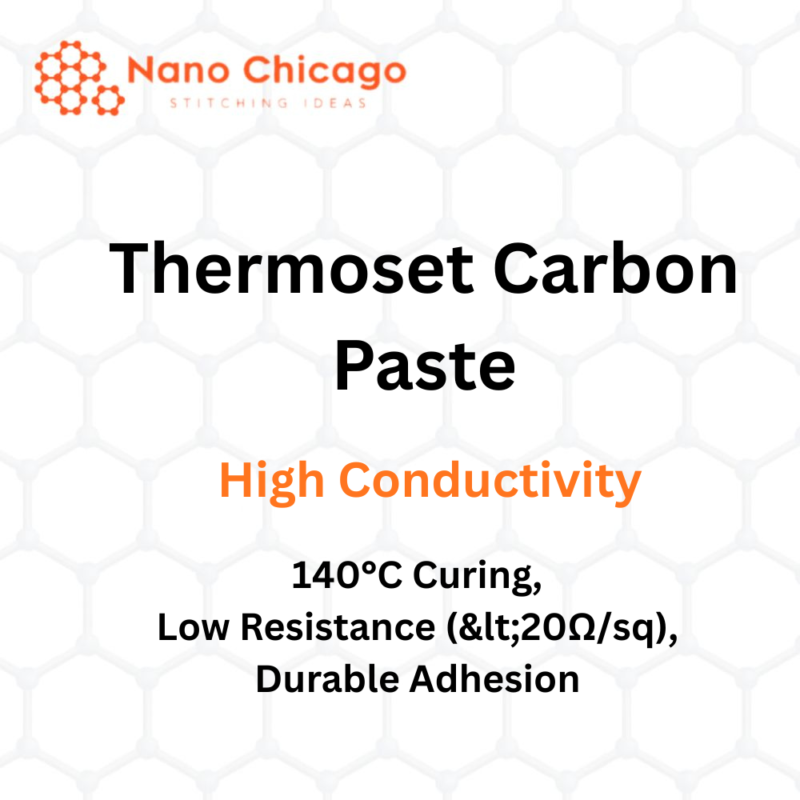
Thermoplastic carbon paste that can be printed in a single pass on one screen is a cutting-edge material with multiple applications in the energy and electronics industries. This advanced carbon-based paste delivers excellent conductivity, thermal stability, and printability. Developed using state-of-the-art research and production techniques, it represents a significant advancement in materials science, meeting the growing demand for high-performance conductive materials. To achieve a sheet resistance of 50 Ω/sqr/25µm, the paste requires low-temperature drying at 140°C. Printed structures should be processed for 30 to 60 minutes at 140°C in a convection oven.
Technical Properties
| Test | Properties |
|---|---|
| Viscosity (Uncured) | 2.5-5 Pa·s @ 50 s^-1 |
| Sheet Resistance (Cured) | 50 Ω/sqr/µm |
| Adhesion | 5B |
| Instrumented Hardness (HIT) | ≈120 MPa |
| Martens Hardness (HM) | ≈95 MPa |
| Substrate | PET, Glass, FR4 |
| Screen | 13 µm emulsion, 325 DPI, SS |
Applications
Printed Electronics: Thermoplastic carbon paste enables flexible circuit formation on polymer substrates with stable electrical conductivity.
Sensors and Biosensors: Serves as a conductive layer in electrochemical and biological sensors, enhancing signal transmission and surface responsiveness.
PV Cells: Used as a printable electrode material in organic and thin-film photovoltaic cells, supporting low-temperature processing and conductivity.
Membrane Keyboards: Provides reliable contact points in pressure-sensitive keyboard layers with durable thermoplastic adhesion.
Energy Storage Devices: Functions as a conductive additive in supercapacitor and battery electrodes, improving charge transfer and cycle stability.
Automotive Electronics: Applied in printed sensor circuits and control modules, offering thermal stability and compatibility with automotive-grade polymers.