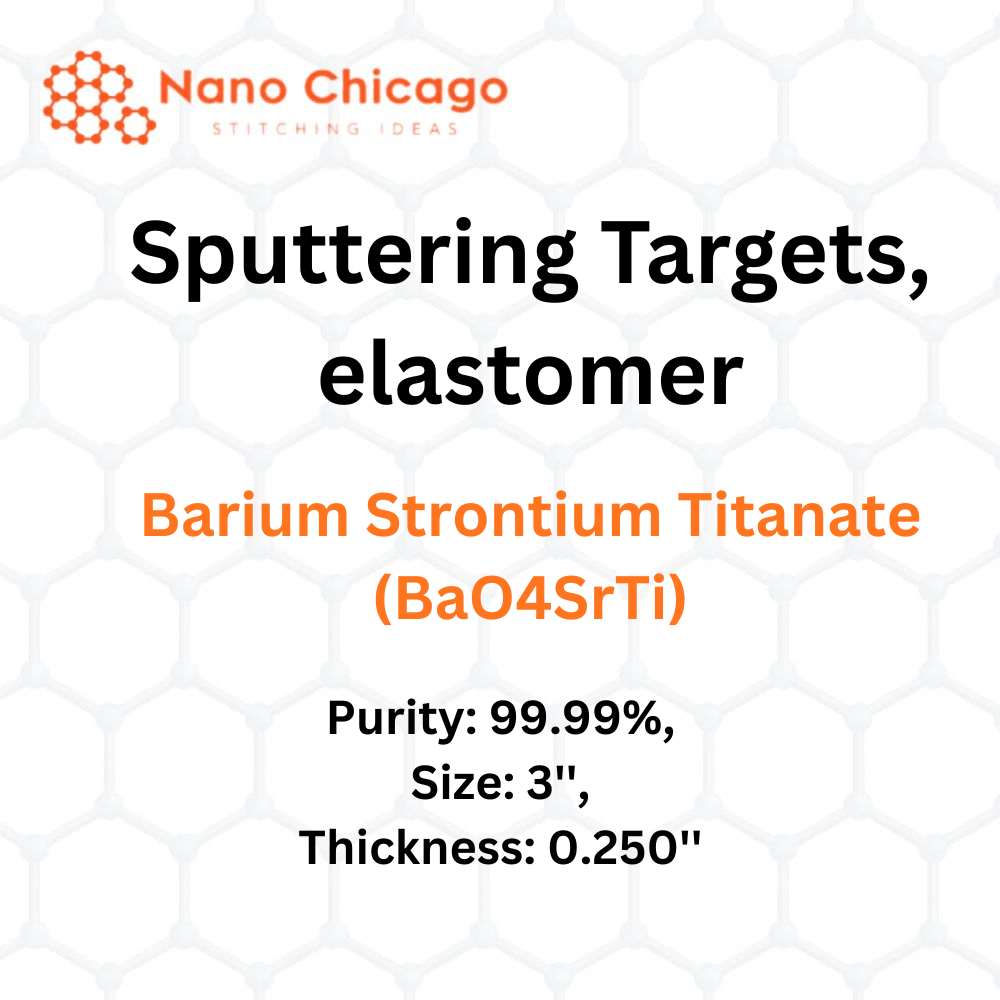
Barium Strontium Titanate (BaO4SrTi) Sputtering Targets, Elastomer
Purity: 99.99% | Size: 3” | Thickness: 0.250”
Sputtering is a well-established technology capable of depositing thin films onto a wide variety of materials and substrate shapes. The process using sputter targets is repeatable and scalable, from small research and development projects to production batches involving medium to large substrate areas. Chemical reactions can occur on the target surface, in-flight, or on the substrate depending on process parameters. While sputter deposition is complex, it provides experts with precise control over film growth and microstructure.
Applications of Sputtering Targets:
-
Sputtering targets are used for thin-film deposition, involving the transfer of material from a “target” source onto a “substrate,” such as a silicon wafer.
-
Semiconductor sputtering targets are employed for etching, particularly when a high degree of etching anisotropy is required and selectivity is not a concern.
-
Sputter targets are also used in analytical techniques, such as secondary ion spectroscopy (SIMS), where the sample is sputtered at a constant rate. The composition of the target material can be determined, and even trace impurities can be detected through mass spectrometry.
Sputtering targets also have applications in space. Sputtering contributes to space weathering, a process that alters the physical and chemical properties of airless bodies, such as asteroids and the Moon.
Barium strontium titanate (BST) is a solid solution of barium titanate (BaTiO3) and strontium titanate (SrTiO3). BST thin films produced via sputtering provide excellent dielectric properties. Consequently, BST-based ferroelectric thin-film devices have become popular over the last decade for tunable microwave applications such as delay lines, resonators, phase shifters, and varactors.
BST thin films are valued for their high dielectric constant, tunability, and low dielectric loss. The dielectric-tunable properties of BST films, deposited through various techniques, have been studied extensively, examining factors such as oxygen vacancies, film thickness, grain size, Ba/Sr ratio, doping concentrations, high-temperature annealing, and multilayer structures to achieve enhanced tunability and reduced dielectric loss.