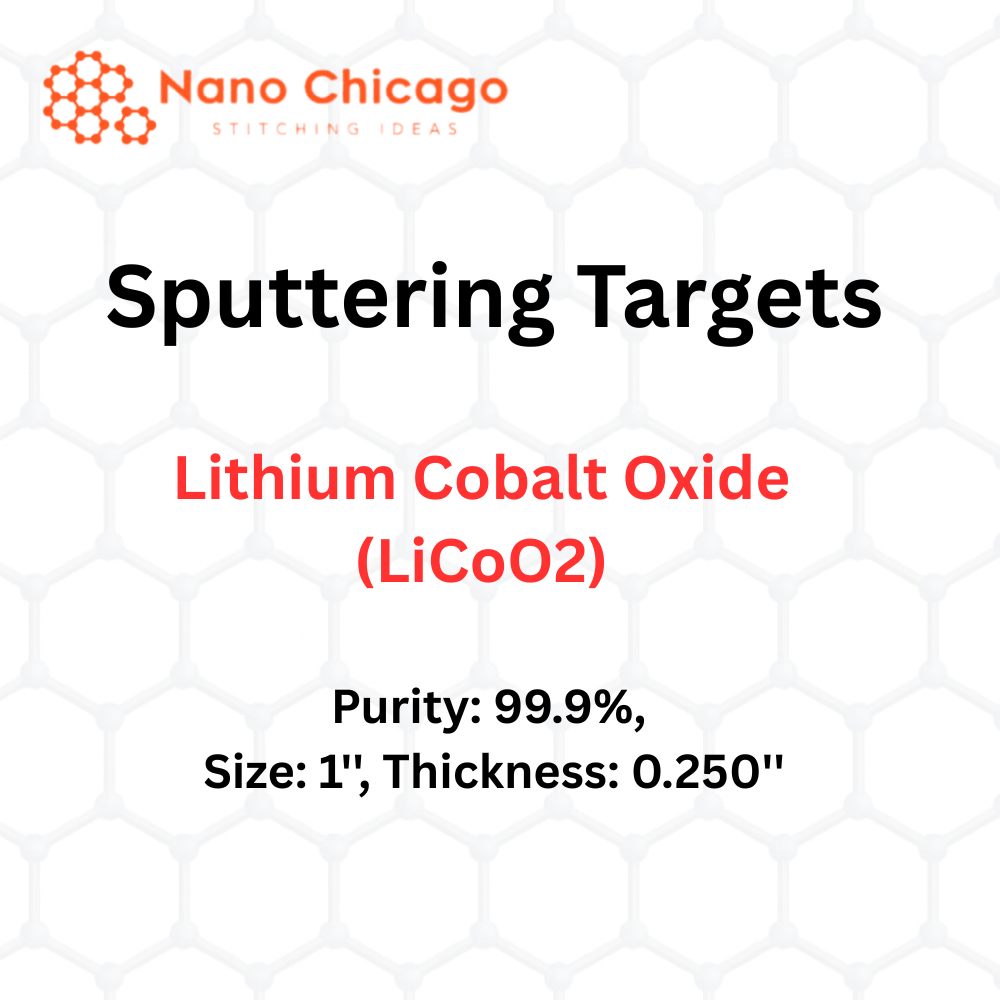
Lithium Cobalt Oxide (LiCoO2) Sputtering Targets
Purity: 99.9%, Size: 1”, Thickness: 0.250”
Sputtering is a proven technology used to deposit thin films from a wide range of materials onto substrates of various shapes and sizes.
The process involving sputter targets is consistent and can be scaled from small research and development projects to medium and large production batches.
Chemical reactions may occur on the target surface, during particle flight, or on the substrate, depending on the process parameters.
Although sputter deposition involves many variables, this complexity allows experts to exercise extensive control over film growth and microstructure.
Applications of Sputtering Targets
Sputtering targets are used for thin-film deposition, a process in which material is eroded from a “target” and deposited onto a “substrate,” such as a silicon wafer.
Semiconductor sputtering targets are used for etching when a high degree of anisotropy is required and selectivity is not a major concern.
Sputter targets are also used in analytical applications by gradually removing material from the target surface.
One example is secondary ion spectroscopy (SIMS), where the target sample is sputtered at a constant rate. As sputtering proceeds, the concentration and identity of the emitted atoms are analyzed using mass spectrometry. With the help of the sputtering target, the composition of the material can be accurately determined, including the detection of extremely low impurity levels.
Sputtering targets also have applications in space. Sputtering is one form of space weathering—a process that alters the physical and chemical properties of airless celestial bodies such as asteroids and the Moon.
Lithium Cobalt Oxide Material Overview
Lithium cobalt oxide (LiCoO2) is a chemical compound with the formula LiCoO2. It is a dark blue or bluish-gray crystalline solid commonly used as the positive electrode material in lithium-ion batteries.
Use of Lithium Cobalt Oxide Sputtering Targets in Batteries
As portable microelectronic devices and sensors continue to shrink in size, the demand for very small batteries increases. Thin-film batteries serve as suitable power sources for low-power electronic devices, including portable electronics and microelectromechanical systems (MEMS), which require minimal power and current and can therefore be powered by thin-film battery technology.
Thin-Film Deposition for Battery Applications
For battery applications, a magnetron sputter system can be used. The required thin-film lithium layer can generally be deposited using conventional sputtering techniques in which a LiCoO2 sputtering target assembly—defined as the LiCoO2 sputtering target bonded to a backing plate—is used to deposit the thin film.
To produce Li thin films, a direct current (D.C.) magnetron sputter system may be employed. The LixCoyO2 sputtering target, represented by the formula LiCoO2, forms part of a cathode assembly placed with an anode inside an evacuated chamber filled with an inert gas, typically argon. Magnets are positioned above the LiCoO2 sputtering target, and a switch connects the target backing plate to a D.C. voltage source. A substrate support is located below the LiCoO2 sputter target within the chamber.
During operation, a high-voltage electric field is applied between the cathode and anode. The inert gas becomes ionized through collisions with electrons emitted from the cathode. The positively charged gas ions are then attracted to the cathode and, upon striking the target surface, dislodge material from the sputtering target. The released material travels across the evacuated chamber and deposits as a LiCoO2 thin film on the substrate, which is typically positioned near the anode.