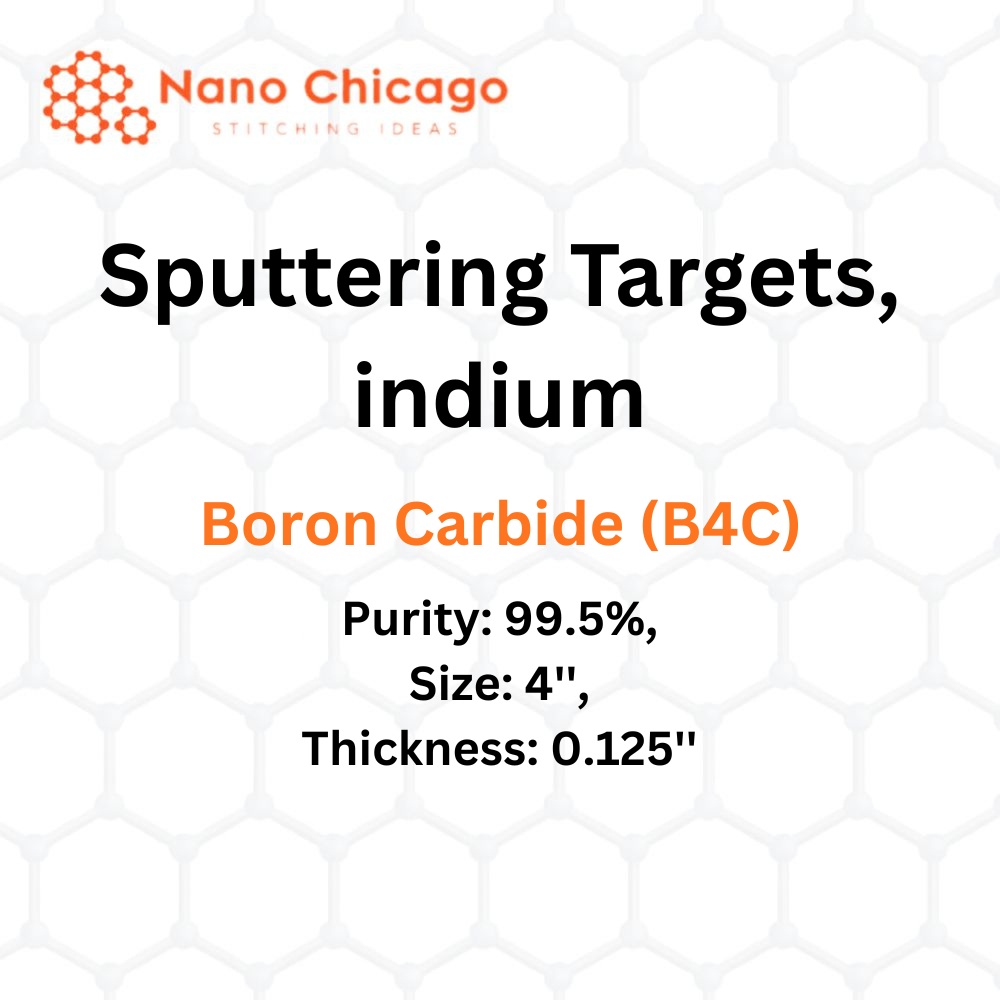
Boron Carbide (B4C) Sputtering Targets, Indium
Purity: 99.5%, Size: 4”, Thickness: 0.125”
Sputtering is a well-established technology capable of depositing thin films from a wide variety of materials onto substrates of diverse shapes and sizes. The process using sputter targets is repeatable and scalable, ranging from small research and development projects to medium- and large-scale production batches. Chemical reactions can occur on the target surface, in-flight, or on the substrate depending on process parameters. While the numerous parameters make sputter deposition complex, they also provide experts with substantial control over the growth and microstructure of the deposited film.
Applications of Sputtering Targets
Sputtering targets are used for film deposition. The deposition achieved with sputter targets involves eroding material from a “target” source onto a “substrate,” such as a silicon wafer. Semiconductor sputtering targets are used for etching the target, especially when a high degree of etching anisotropy is required and selectivity is not a concern. Sputter targets are also utilized in analytical applications by etching away the target material. One example is secondary ion spectroscopy (SIMS), where the target sample is sputtered at a constant rate. As the target is sputtered, the concentration and identity of sputtered atoms are measured using mass spectrometry. With the help of the sputtering target, the composition of the material can be determined, even detecting extremely low concentrations of impurities.
Sputtering targets also have applications in space. Sputtering is a form of space weathering, a process that alters the physical and chemical properties of airless bodies such as asteroids and the Moon.
Material Overview
Boron carbide is a heat- and chemically-resistant refractory compound of boron and carbon with the chemical formula B4C. It exists in various crystalline forms that are isoelectronic to a similarly structured carbon lattice. The hexagonal form is the most stable and softest among B4C polymorphs, making it suitable for use in lubricants and as an additive in certain industrial applications. The cubic structure variety, analogous to diamond, is called c-B4C; it is softer than diamond but possesses superior thermal and chemical stability. Due to these properties, boron carbide ceramics are traditionally used in high-temperature and wear-resistant applications.
Properties and Advantages
Cubic boron carbide (c-B4C) has been increasingly used as a coating material for cutting tools because of its excellent mechanical and chemical properties. Key properties of boron carbide include:
-
High hardness
-
Low friction coefficient
-
Good thermal conductivity
-
High electrical resistivity
-
High wear resistance
-
Chemical inertness at elevated temperatures
Boron carbide is one of the hardest materials available after diamond and surpasses diamond in chemical stability against oxygen and ferrous materials at high temperatures.
Polymorphs and Coating Applications
Boron carbide coatings primarily consist of two polymorphs: hexagonal boron carbide (h-B4C) and cubic boron carbide (c-B4C). Hexagonal boron carbide is known for being soft, having a low friction coefficient, electrically insulating, and thermally conductive. It is widely applied as a solid lubricant in metal forming dies and high-temperature metal forming processes.
In contrast, cubic boron carbide exhibits extreme hardness and other superior properties, making it an ideal coating material for cutting tools. Its use has grown in applications such as dry cutting, high-speed machining, and cutting hard materials. Sintered c-B4C cutting tools are already widely used, though their high cost, limited ductility, and difficulty in shaping remain challenges.
The demand for B4C thin and thick films has expanded not only for cutting applications but also for protective coatings, optical coatings, and electrical insulating layers. Among various coating techniques, sputtering—a physical vapor deposition (PVD) method—has gained prominence due to lower coating temperatures, the ability to deposit thinner coatings, and the capacity to coat sharp edges and complex forms.