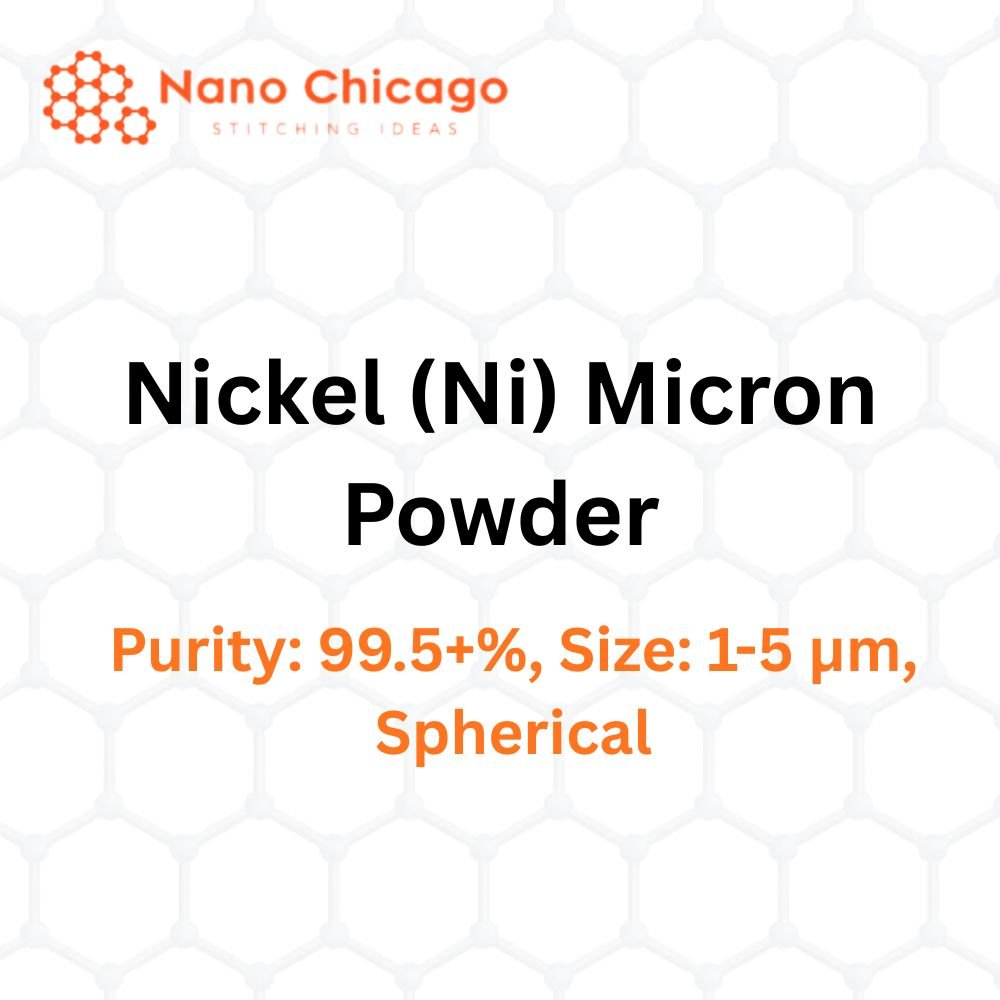
Nickel (Ni) Micron Powder
Purity: 99.5+%, Size: 1–5 µm, Spherical
Technical Properties:
| Property | Value |
|---|---|
| Purity (%) | 99.5+% |
| Particle Size (µm) | 1–5 |
| CAS | 7440-02-0 |
| Melting Point (°C) | 1453 |
| Boiling Point (°C) | 2730 |
| Density (g/cm³) | 8.908 |
| Brinell Hardness | 75 (Annealed) |
| Coefficient of Expansion @ 20 °C | 13.3 × 10⁻⁶ |
| Electric Resistivity | 6.844 microhm·cm |
| Form | Powder |
| Color | Gray |
| Morphology | Spherical |
| Elemental Analysis (%) | |
| C | ≤0.5 |
| O | ≤3 |
Applications:
Nickel micron powder offers high purity, uniform spherical morphology, and excellent electrical and thermal conductivity, making it a versatile industrial material. Key application areas include:
- Alloys & Metal Matrix Composites: Enhances mechanical strength and corrosion resistance in aerospace, automotive, and structural alloys.
- Electronics & EMI Shielding: Used in conductive pastes and coatings for PCBs, EMC layers, and shielding materials.
- Thermal Interface Materials: Improves thermal conductivity in greases, pads, and high-power electronic cooling systems.
- Energy Storage: Acts as an additive in lithium-ion batteries and supercapacitors for improved charge rates and cycle life.
- Additive Manufacturing: Suitable for SLS and binder jetting, providing stable sintering behavior and uniform microstructures.
- Catalysis & Fuel Cells: Serves as a support and active phase in hydrogen production, catalytic reactions, and fuel-cell electrodes.
- Advanced Composites: Incorporated into polymer and ceramic matrices to enhance conductivity, durability, and thermal stability.