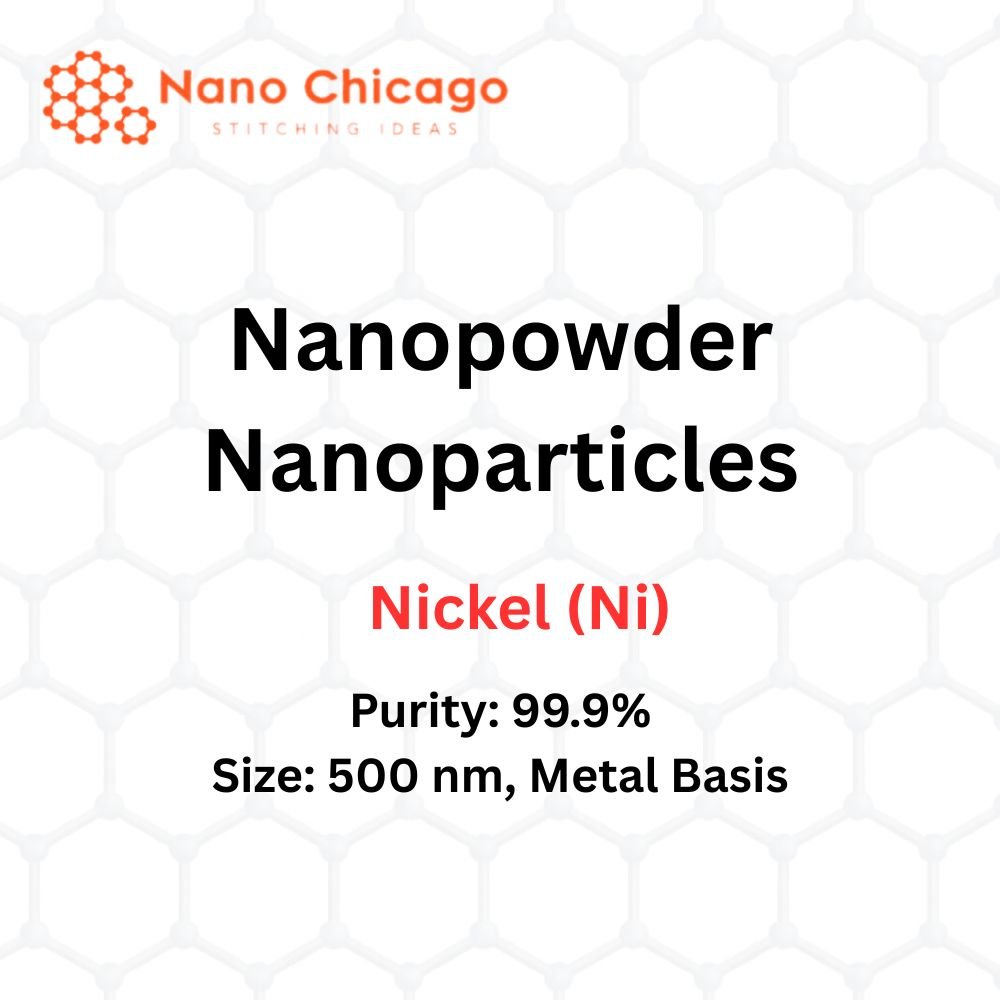
Nickel (Ni) Nanopowder/Nanoparticles
Purity: 99.9%, Size: 500 nm, Metal Basis
Technical Properties:
| Property | Value |
|---|---|
| True Density (g/cm3) | 8,9 |
| Color | dark gray |
| Crystal Structure | cubic |
| Tmelting (°C) | 1455 |
| Tboiling (°C) | 2730 |
| Average Particle Size (nm) | 500 |
Elemental Analysis (%):
| Element | Ni | C | Co | Mg | Fe |
|---|---|---|---|---|---|
| Value | ≥99.9 | ≤0.035 | ≤0.004 | ≤0.008 | ≤0.003 |
Properties, Storage and Cautions:
Nickel nanoparticles possess a nanoscale structure that provides exceptionally high specific surface area, enhanced chemical reactivity, strong ferromagnetic behavior, and notable catalytic activity compared to bulk nickel. However, in nanopowder form, they are highly reactive, flammable, and prone to oxidation, requiring strict handling procedures.
Because of their combustibility and sensitivity to environmental factors, the powder must be handled with extreme care—avoiding rapid movements, mechanical vibrations, and physical impacts. Exposure to air, sunlight, heat, and moisture can lead to oxidation, agglomeration, or hazardous reactions. To minimize risks and maintain material integrity, the nanopowder should be stored sealed under vacuum or in an inert atmosphere, in a cool, dry, and dark environment. This reduces moisture absorption, particle coagulation, and thermal degradation.
Applications:
-
Catalysis: Effective in hydrogenation, reforming, hydrogen evolution reactions (HER), and as support for fuel-cell reactions and carbon nanotube growth.
-
Energy Storage: Used as electrode material for lithium-ion batteries and supercapacitors; incorporated into conductive inks for flexible electronics and printed photovoltaics.
-
Magnetic Devices: Applied in high-density data storage, ferrofluids, magnetic sensors, and microwave applications due to high coercivity and magneto-crystalline anisotropy.
-
Additive Manufacturing and Composites: Serves as a sintering additive and reinforcement in metal and ceramic matrices, enhancing mechanical and thermal properties.
-
Propellants: Functions as a combustion catalyst in solid and liquid propellant formulations, improving burn rates and energy output.
-
Biomedical & Surface Protection: Investigated for MRI contrast agents, drug-delivery vectors, antimicrobial coatings, and corrosion-resistant surface layers.