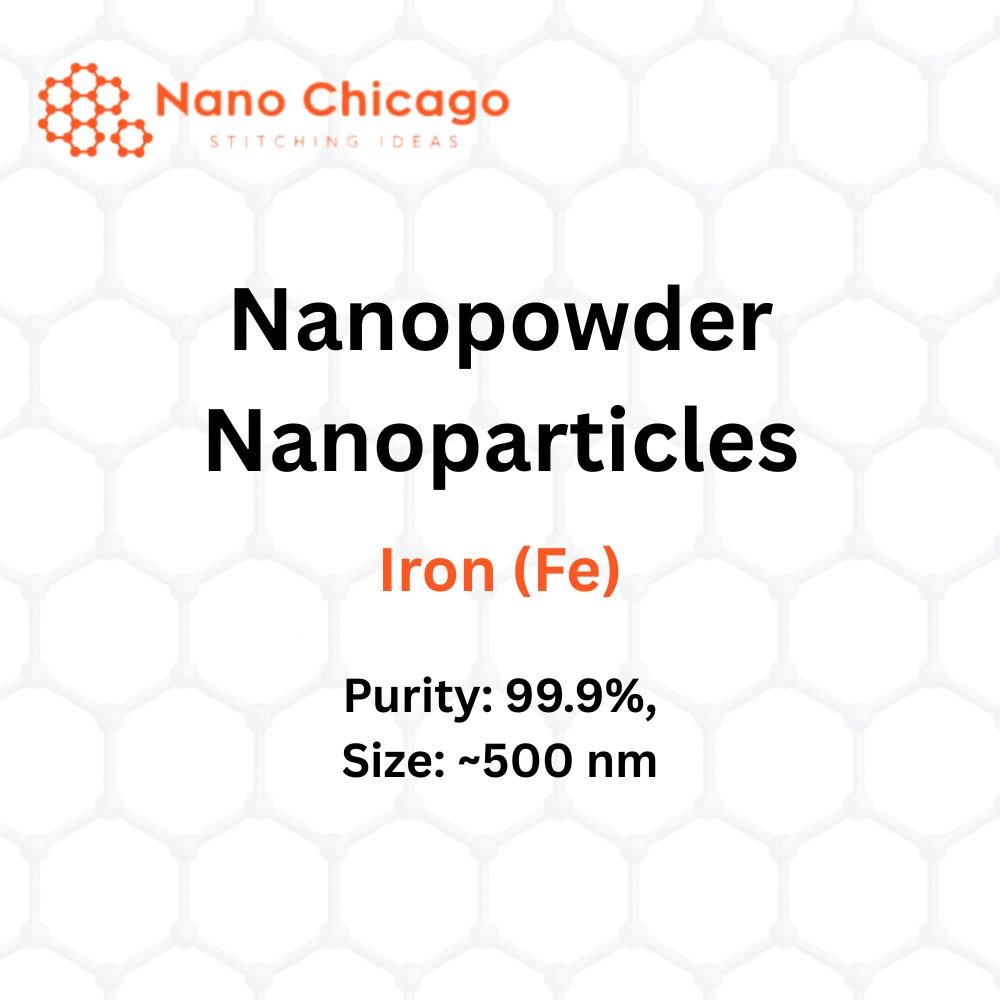
Iron (Fe) Nanopowder/Nanoparticles
Purity: 99.9%, Size: ~500 nm
Technical Properties:
| Property | Value |
|---|---|
| Purity | 99.9% |
| Average Particle Size | ~500 nm |
| CAS No | 7439-89-6 |
Elemental Analysis (ppm wt):
| Element | Mg | Zn | Mn | Cu | Cr | Al |
|---|---|---|---|---|---|---|
| Value | 80 | 50 | 40 | 40 | 20 | 20 |
Properties, Storage, and Cautions:
Iron nanoparticles are highly reactive and flammable, so they must be handled with care. Rapid movements and vibrations should be avoided. The nanopowder must be protected from sunlight, heat, moisture, and physical impacts. Since particle coagulation is a significant concern, the material should be sealed under vacuum and stored in cool, dry conditions. Air exposure should be avoided.
Applications:
-
Biomedical: Used in magnetic hyperthermia, targeted drug delivery, and biosensing platforms where magnetic responsiveness and surface functionalization are essential.
-
Environmental: Applied in groundwater remediation and pollutant reduction through redox-active surfaces, particularly for chlorinated organics and heavy metals.
-
Catalysis & Energy: Function as active sites in hydrogen production, fuel cell reactions, and electrocatalytic processes due to high surface area and electron-transfer capability.
-
Magnetic Devices: Incorporated into magnetic separation systems, sensor platforms, and prototype data-storage media with tunable coercivity and magnetic saturation.
-
Materials Engineering: Utilized as sintering aids, grain refiners, and reinforcement additives in metal and ceramic matrices to enhance mechanical and thermal performance.
-
Chemical Processing: Employed in reactive formulations and surface-driven transformations where iron’s catalytic properties support process efficiency and selectivity.