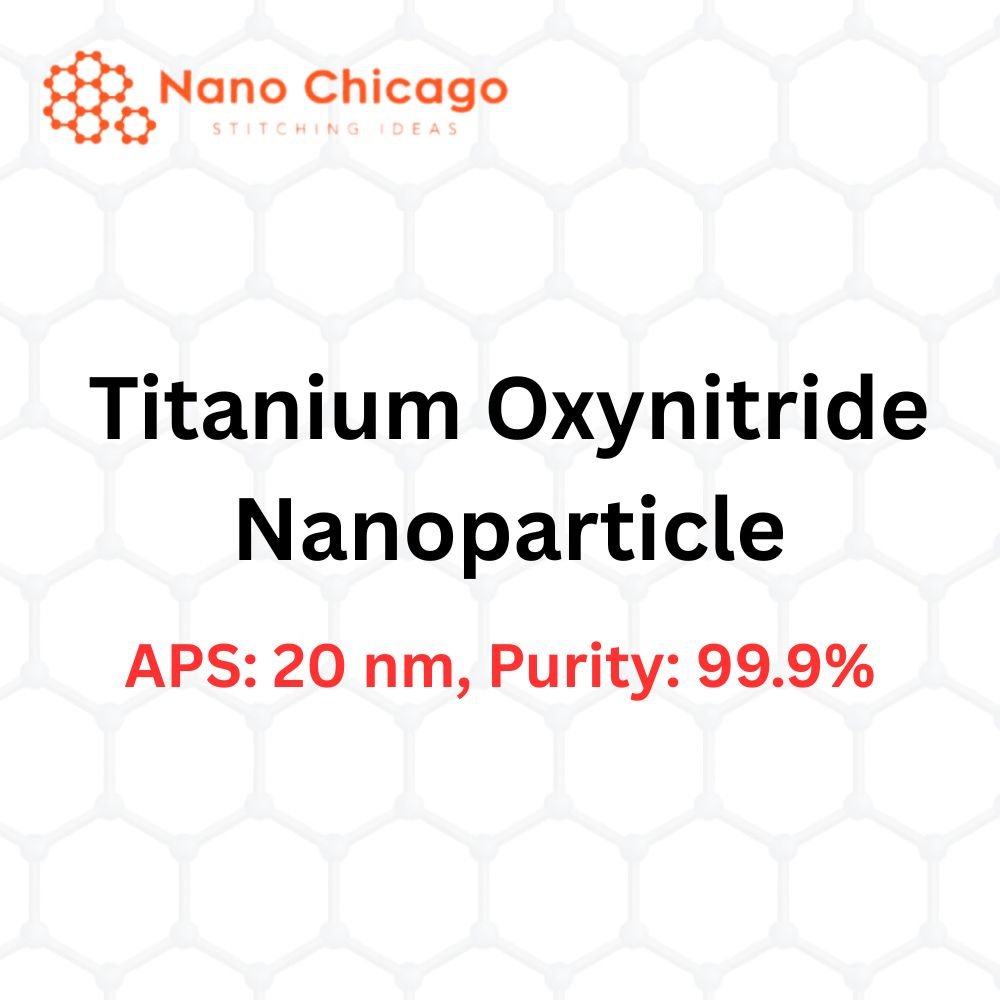
Titanium Oxynitride Nanoparticles
Average Particle Size: 20 nm, Purity: 99.9%
Performance Characteristics
Nano titanium oxynitride powder is produced using a high-frequency plasma gas-phase synthesis method. It features high purity, absence of carbon black dot impurities and ammonium chloride residues, small and uniformly distributed particle size, large specific surface area, high surface activity, and low bulk density. As a photocatalyst material, nano-TiON offers stable chemical properties, strong redox capability, resistance to photocathode corrosion, insolubility, non-toxicity, and low cost. It is widely used as a catalyst for photocatalytic oxidation reactions, enabling the removal of atmospheric and water pollutants and serving as an ideal material for addressing energy and environmental challenges.
Product Parameters
| APS | 20 nm |
|---|---|
| Purity | 99.9 % |
| BET Surface Area | 68.12 m²/g |
| Theoretical Density | 4.300 g/cm³ |
| Bulk Density | 0.05 g/cm³ |
| Melting Point | 1400 °C |
| Boiling Point | 2000 °C |
| Shape | Nearly Spherical |
| Color | White |
| Manufacturing Method | CVD |
Applications
Nano titanium oxynitride is used in sewage treatment: Industrial wastewater contains many toxic and harmful organic compounds that are difficult to eliminate using biological treatment technologies. Under light exposure, nano-TiON exhibits strong oxidizing ability, enabling hydrocarbons, halogenated substances, carboxylic acids, and similar pollutants to undergo redox reactions and gradually degrade into environmentally friendly CO₂, H₂O, and other harmless substances.
Nano titanium oxynitride is used in photocatalysts: With a band gap smaller than 3.2 eV, nano-TiON can catalytically degrade toxic and harmful airborne substances under visible light with wavelengths above 400 nm, offering superior environmental purification performance compared to pure titanium dioxide photocatalysts.
Nano titanium oxynitride is used in self-cleaning coatings: Its strong catalytic oxidation capability enables automatic decomposition of organic contaminants on coated surfaces, degrading them into CO₂, water, and other substances that are subsequently removed by air circulation, achieving a self-cleaning effect.
Nano titanium oxynitride is used as an antibacterial agent: Nano-TiON provides strong photocatalytic sterilization. Under visible light, it decomposes water into free radicals that penetrate bacterial cell walls, disrupt cell structures, and eliminate bacterial cells, providing antibacterial and bactericidal effects.
Nano titanium oxynitride is used in antibacterial composite materials: Due to its strong photocatalytic properties, adding nano-TiON to polymer materials such as plastics, rubber, and fibers produces composite materials that resist mold and bacteria growth, even under low-light conditions.
Nanometer titanium oxynitride is used in aerospace applications: It can serve as an ultra-thin coating to harden and protect smooth surfaces and can also be utilized as a non-toxic material in medical implants.
Packaging and Storage
This product is packaged in an inert gas–filled plastic bag and should be sealed and stored in a dry, cool environment. Avoid exposure to air to prevent oxidation and moisture-induced agglomeration, which may affect dispersion and performance. Packaging quantities can be customized based on customer requirements.