DESCRIPTION
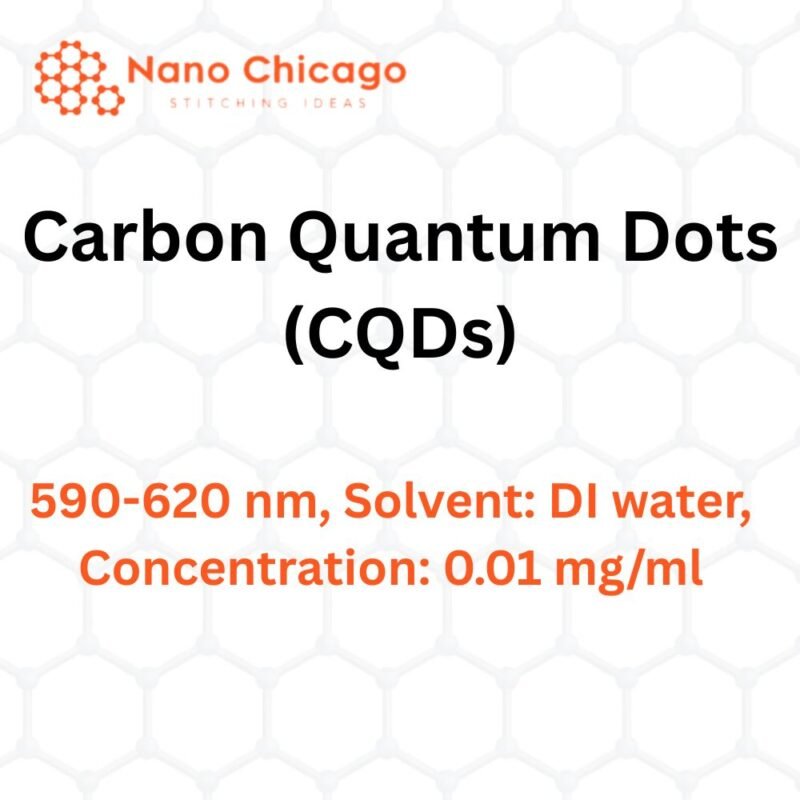
Carbon Quantum Dots (CQDs) emitting in the 590–620 nm range generate vivid orange photoluminescence from quantum-confined sp² domains enriched with surface functional groups, including carboxyl, hydroxyl, and amino moieties. These functional groups tune the band-gap to approximately 2.1 eV, offering excellent water dispersibility, pH-dependent fluorescence, and facile chemical conjugation. Synthesized through eco-friendly, low-temperature methods—such as hydrothermal carbonization of citric acid or microwave pyrolysis of biomass—orange CQDs demonstrate strong photostability, low cytotoxicity, and quantum yields exceeding 30% after heteroatom (N, S) doping or surface passivation. Their intense, broad-excitation emission allows for multiplexed bioimaging and fluorescent probes, while their warm color coordinates enable plant-growth lighting, OLED down-conversion layers, and orange micro-LED inks. Overall, 590–620 nm CQDs provide tunable optical properties, environmentally friendly composition, and versatile surface chemistry, making them a scalable and cost-effective alternative to heavy-metal-based quantum dots for next-generation optoelectronic, biomedical, and sensing applications.
Technical Properties of Carbon Quantum Dots
| Property |
Value |
| Diameter |
<15 nm |
| Morphology |
Spherical |
| Emission Wavelength Range |
590–620 nm |
| Color |
Orange |
| Solvent |
DI Water |
| Concentration |
0.01 mg/ml |
Analyses Provided
| Analysis Type |
Details |
| Standard Analysis |
Excitation and Emission wavelength measured with PL Spectrophotometer |
| Additional Analyses (Extra Fee) |
Particle Size Distribution, Quantum Yield, Fluorescence Lifetime |
Applications of Carbon Quantum Dots
| Application Area |
Description |
| Biomedical Applications |
Used in bioimaging, biosensing, and drug delivery due to excellent water solubility, low cytotoxicity, and strong fluorescence. Suitable for real-time cellular imaging and diagnostic systems. |
| Optoelectronics & Displays |
Serve as down-conversion materials in LEDs, OLEDs, micro-LEDs, and photodetectors because of stable orange emission and broad excitation response. |
| Sensing Technologies |
Applied in chemical and biological sensors for detecting metal ions, biomolecules, and environmental toxins through fluorescence quenching/enhancement mechanisms. |
| Plant Growth & Agriculture |
Orange CQDs match the PAR spectrum, enabling use in agricultural lighting, smart fertilizers, and plant health monitoring systems. |
| Environmental & Energy Applications |
Utilized in photocatalysis, pollutant degradation, water treatment, and energy-harvesting systems such as solar cells due to stable redox behavior and light-absorption properties. |
Additional Applications
Carbon nanotubes doped with metallic nanopowders provide significant enhancements in both electrical and mechanical performance. These improvements include increased hardness, tensile strength, specific strength, and elastic modulus. As a result, these materials are widely utilized across various fields. Some of these applications include: 1-drug delivery, 2-biosensors, 3-CNT composites, 4-catalysis, 5-nanoprobes, 6-hydrogen storage, 7-lithium batteries, 8-gas-discharge tubes, 9-flat panel displays, 10-supercapacitors, 11-transistors, 12-solar cells, 13-photoluminescence, 14-templates.
For larger inquiries, please contact us.
Download ……………………….. MSDS